
Advanced Excel Interview Questions and Answers for Freshers (2026)
MS Office Course Advantages and Disadvantages Home Blogs Contact Us Lorem ipsum dolor sit amet,
Call Now : 9390612347
Call Now : 8096061003
Call Now : 9000709021
Lorem ipsum dolor sit amet, consectetur adipiscing elit. Ut elit tellus, luctus nec ullamcorper mattis, pulvinar dapibus leo.
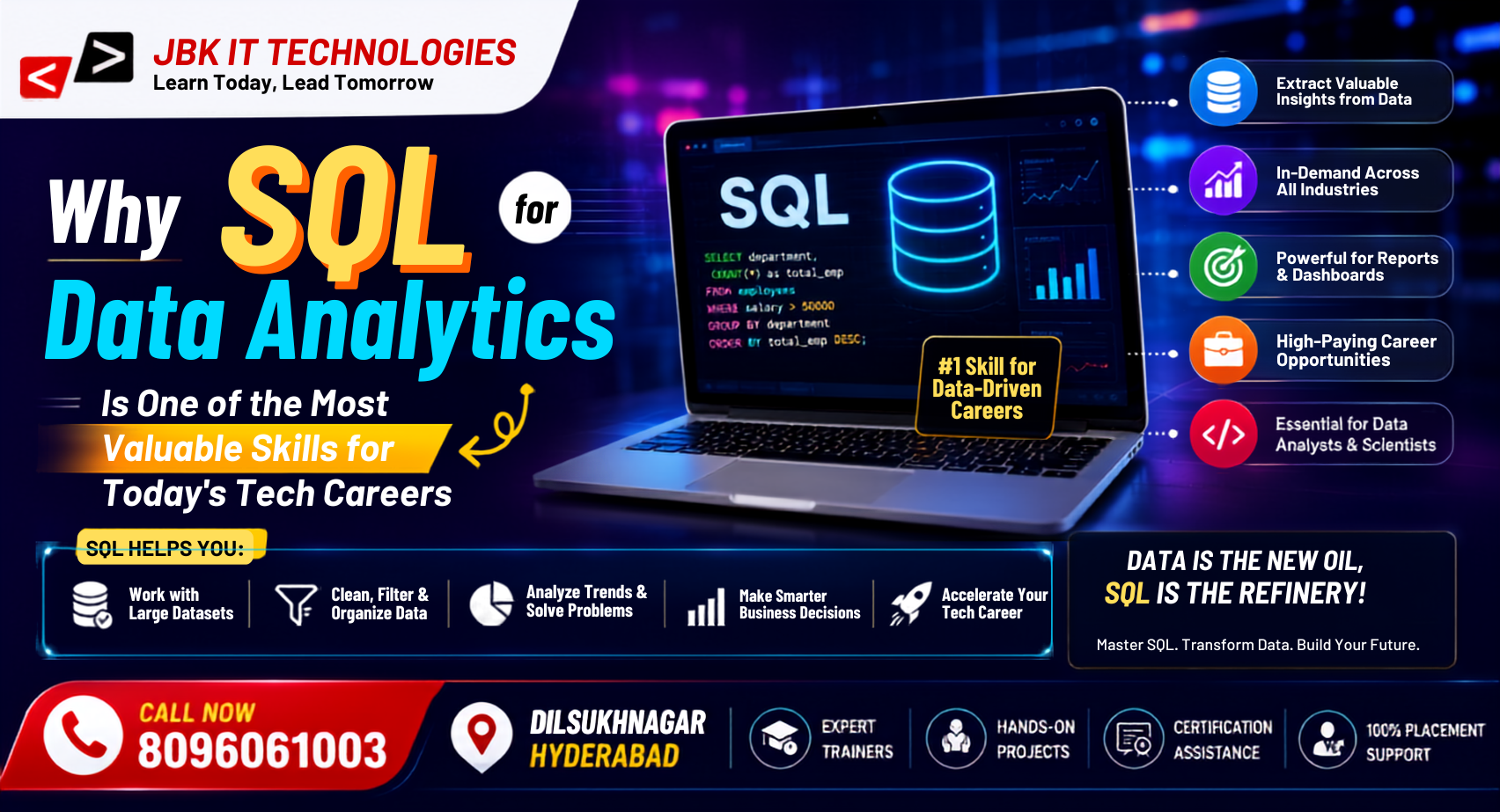
The modern world runs on data. Every online purchase, social media interaction, banking transaction, and business operation generates valuable information that organizations use to make strategic decisions. As companies continue to collect enormous amounts of data, the demand for professionals who can understand, manage, and analyze that information is growing rapidly. This is one of the primary reasons why SQL for data analytics has become one of the most valuable and sought after skills in today’s technology driven job market.
Whether you are a student exploring career options, a working professional looking to upgrade your skills, or a job seeker aiming to enter the IT industry, learning SQL can significantly improve your career prospects. SQL, or Structured Query Language, is the standard language used to communicate with databases. It enables professionals to retrieve, organize, analyze, and manage data efficiently. Because data forms the foundation of business decision making, SQL continues to be an essential skill across industries.
In this article, we will explore why SQL remains highly relevant in the era of artificial intelligence and big data, how it supports modern business operations, the career opportunities it creates, and why enrolling in an SQL course in Dilsukhnagar or SQL training in Hyderabad can help you build a successful future in data analytics.
SQL, which stands for Structured Query Language, is the language used to interact with relational databases. Organizations store vast amounts of information in databases, including customer records, financial transactions, employee information, inventory details, and sales data. SQL acts as the bridge between users and these databases, allowing professionals to retrieve the exact information they need.
Imagine an online shopping company that processes thousands of orders every day. The company stores customer details, product information, payment records, and order histories in different database tables. SQL enables analysts to connect these tables, identify trends, generate reports, and uncover valuable business insights. Without SQL, accessing and analyzing such large volumes of information would be extremely difficult and time-consuming.
Because of its simplicity and efficiency, SQL has become the industry standard for database management and data analysis. It is supported by leading database systems such as MySQL, Microsoft SQL Server, PostgreSQL, Oracle Database, and many cloud-based platforms used by organizations around the world.
Technology continues to evolve at an incredible pace, but SQL remains one of the few skills that has maintained its importance for decades. The reason is straightforward: data is stored in databases, and SQL is the most effective way to access that data.
Businesses rely on data driven decision making more than ever before. Before organizations can build dashboards, generate reports, or apply artificial intelligence models, they need to retrieve accurate information from databases. SQL makes this process possible. Data analysts, business analysts, data engineers, and SQL developers use SQL daily to extract meaningful information that supports strategic planning and operational improvements.
Another reason for SQL’s continued popularity is its universal adoption across industries. From healthcare and banking to retail and technology, organizations of all sizes depend on SQL for managing and analyzing business data. This widespread use ensures that SQL remains one of the most marketable skills for professionals seeking long term career growth.
Becoming proficient in SQL for data analytics involves much more than learning basic commands. Data analysts use SQL to solve business problems, identify trends, and support decision making processes. A strong understanding of SQL queries enables professionals to retrieve relevant information from complex databases quickly and accurately.
Analysts often work with multiple tables containing related information. SQL allows them to combine data from different sources, creating a complete picture of business performance. For example, an analyst may connect customer records with sales transactions to determine purchasing patterns or identify high value customers.
Advanced SQL skills include data filtering, sorting, grouping, aggregation, and joining multiple datasets. These techniques help analysts transform raw data into actionable insights. Understanding database management concepts such as indexing, normalization, and query optimization also improves performance and efficiency when working with large databases.
Employers increasingly value professionals who can not only write SQL queries but also understand how databases function behind the scenes. This combination of analytical and technical expertise makes SQL professionals highly valuable in today’s job market.
Every successful business decision relies on accurate information. SQL plays a critical role in helping organizations access and analyze the data needed to make informed choices.
For example, retail companies use SQL for data analytics to understand which products generate the highest revenue, identify seasonal sales trends, and monitor inventory levels. Marketing teams rely on SQL to measure campaign performance, evaluate customer engagement, and track conversion rates. Financial departments use SQL to generate reports, analyze profitability, and monitor expenses.
Customer analytics is another area where SQL delivers significant value. Organizations use SQL to understand customer behavior, identify retention opportunities, and personalize experiences. By analyzing historical data, companies can make predictions about future trends and develop strategies that improve customer satisfaction and business growth.
The ability to transform raw information into meaningful insights is what makes SQL such an important skill for modern organizations. Businesses that effectively use data gain a competitive advantage, making SQL professionals an essential part of their success.
One of the greatest advantages of learning SQL is its versatility. Unlike some specialized technologies that are limited to specific industries, SQL for data analytics is used almost everywhere.
In the banking and financial sector, SQL helps organizations analyze transactions, detect fraud, manage risk, and generate regulatory reports. Healthcare providers use SQL to manage patient information, monitor treatment outcomes, and improve operational efficiency. E-commerce companies depend on SQL for customer analytics, inventory management, and sales forecasting.
Telecommunications organizations use SQL to process massive amounts of customer and network data. Educational institutions rely on databases to manage admissions, attendance, examinations, and academic records. Technology companies use SQL extensively to support software applications, business intelligence systems, and cloud-based platforms.
Because SQL is relevant across so many industries, professionals with SQL expertise enjoy greater flexibility when exploring career opportunities.
Learning SQL for data analytics opens the door to a wide range of career opportunities in both technical and business-focused roles. One of the most common career paths is becoming a Data Analyst. Data analysts use SQL to collect, clean, and interpret data, helping organizations understand performance and identify opportunities for improvement.
Another popular role is SQL Developer. These professionals focus on designing, maintaining, and optimizing databases while developing efficient SQL queries that support business applications. Business Analysts also use SQL extensively to analyze operational data and recommend process improvements.
Database Administrators are responsible for managing database systems, ensuring security, performance, and reliability. Business Intelligence Developers use SQL alongside tools such as Power BI and Tableau to create dashboards and reports that support executive decision-making.
As organizations continue investing in data-driven strategies, demand for SQL professionals remains strong. Many employers consider SQL a mandatory skill when hiring for analytics and technology-related positions, making it an excellent investment for career growth.
Some people assume that newer technologies such as artificial intelligence and machine learning have reduced the importance of SQL. In reality, the opposite is true. Modern analytics tools still rely heavily on SQL for data analytics because databases remain the primary source of business data.
Power BI and Tableau, two of the world’s most popular business intelligence platforms, often use SQL queries to retrieve information from databases. Python, a leading programming language for data science, is frequently combined with SQL to perform advanced analytics and machine learning tasks.
Cloud platforms such as Amazon Web Services, Microsoft Azure, and Google Cloud also support SQL databases. As organizations move their infrastructure to the cloud, professionals with SQL expertise become even more valuable.
Rather than being replaced by emerging technologies, SQL continues to evolve alongside them, maintaining its position as a foundational skill in the data ecosystem.
The digital economy is creating unprecedented demand for professionals who can work with data. Organizations are investing heavily in analytics, automation, artificial intelligence, and business intelligence solutions. At the center of all these technologies lies data, and SQL remains one of the most effective tools for accessing and managing that data.
For students, learning SQL provides a strong foundation for careers in analytics, data science, and information technology. For professionals, SQL creates opportunities for career advancement, higher salaries, and transitions into specialized data focused roles. For job seekers, SQL demonstrates technical competency and analytical thinking, qualities that employers consistently value.
The growing importance of data driven decision making means that SQL will remain relevant for years to come. Professionals who invest time in mastering SQL today are positioning themselves for long term success in an increasingly competitive job market.
As demand for SQL for data analytics professionals continues to grow, many students and working professionals are seeking quality training programs. A well-structured SQL course in Dilsukhnagar or SQL training in Hyderabad should focus on practical learning rather than theoretical concepts alone.
The best training programs provide hands-on experience with real-world databases, allowing students to work on projects that simulate actual business scenarios. Training should cover SQL fundamentals, advanced querying techniques, database management concepts, reporting, and integration with analytics tools.
Practical exposure is especially important because employers often evaluate candidates based on their ability to solve real business problems using SQL. Institutes that offer project-based learning, interview preparation, and placement support can significantly improve career outcomes for aspiring SQL professionals.
.
Artificial intelligence is transforming industries worldwide, but it is also increasing the importance of SQL for data analytics. AI systems depend on large amounts of structured, high quality data. Before machine learning models can be trained, data must be collected, cleaned, organized, and prepared. SQL remains one of the most efficient tools for performing these tasks.
As businesses continue generating larger volumes of information, the need for professionals who can manage and analyze data will only increase. Industry experts consistently identify SQL as one of the most valuable skills for careers in analytics, business intelligence, cloud computing, and artificial intelligence.
Far from becoming obsolete, SQL is becoming even more relevant as organizations expand their use of data-driven technologies. This makes SQL one of the safest and most future proof skills that students and professionals can learn today.
SQL for data analytics is much more than a technical skill it is a gateway to some of the most exciting and rewarding careers in today’s technology landscape. Its ability to retrieve, manage, and analyze business data makes it indispensable across industries ranging from finance and healthcare to e commerce and information technology.
As organizations continue embracing digital transformation and data driven decision making, professionals with SQL expertise will remain in high demand. Whether you are a student planning your future, a professional seeking career advancement, or a job seeker looking to enter the analytics field, learning SQL can open doors to countless opportunities.
For aspiring professionals in Telangana, enrolling in an SQL course in Dilsukhnagar or participating in SQL training in Hyderabad can provide the practical skills and industry knowledge needed to succeed in the rapidly growing world of data analytics.
This version is fully descriptive, SEO friendly, and optimized for both Google search and AI search engines while maintaining a natural reading flow.
MS Office Course Advantages and Disadvantages Home Blogs Contact Us Lorem ipsum dolor sit amet,
Python vs Java: Which Course Should Beginners Choose in 2026? Home Blogs Contact Us Choosing
What Are VBA Macros and How Do They Help in Excel Automation? Home Blogs Contact
Why MS Office Skills Are Important for Freshers and Office Jobs Home Blogs Contact Us
Why SQL for Data Analytics Is One of the Most Valuable Skills for Today’s Tech
GST and ITR Filing Skills Every Accounting Student Should Learn Home Blogs Contact Us Lorem