Ameerpet Hyderabad

Call Now : 9390612347

Dilsukhnagar Hyderabad

Call Now : 8096061003

Mehdipatnam Hyderabad

Call Now : 9000709021

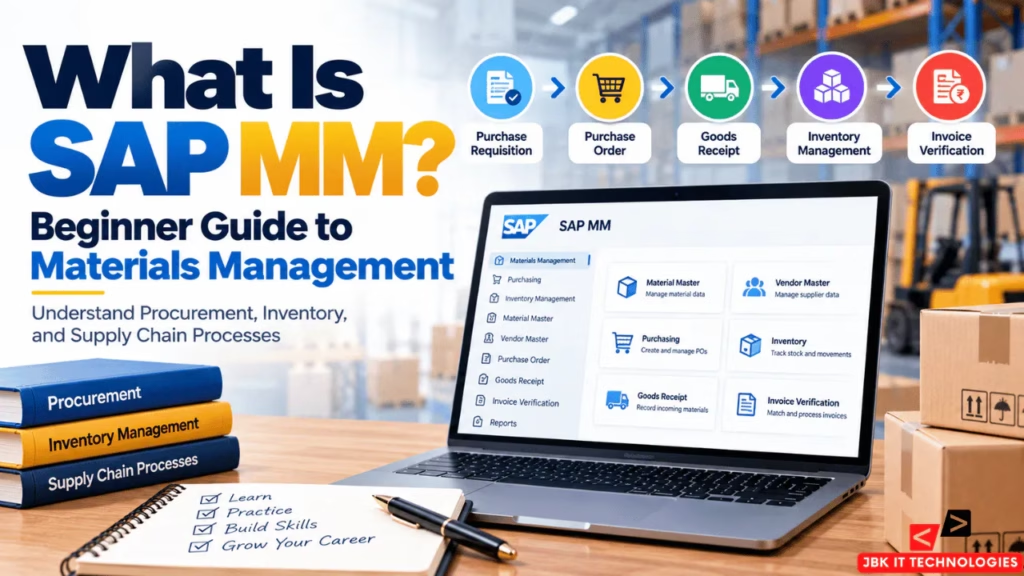
What Is SAP MM? Beginner Guide to Materials Management

When a company purchases raw materials, receives goods from suppliers, stores inventory, transfers stock between locations, and verifies supplier invoices, it needs a structured way to manage these activities.

This is where SAP MM comes into the picture.

SAP MM, traditionally known as SAP Materials Management, is an SAP module associated with procurement and inventory-related processes. It supports activities such as purchasing, goods receipt, inventory management and invoice verification. SAP documentation describes Materials Management purchasing as supporting materials planning, purchasing, goods receipt, inventory management and invoice verification.

For a beginner, SAP MM can seem complicated because it involves several connected business processes. However, once you understand the basic flow, the module becomes much easier to learn.

This guide explains what SAP MM is, where it is used, how procurement works, how inventory is managed, important SAP MM concepts, the difference between SAP MM and SAP FICO, who can learn it, possible job roles, and a practical beginner learning path.

What Is SAP MM?

SAP MM stands for SAP Materials Management.

It is a functional area within SAP ERP that supports business processes related to purchasing, materials and inventory.

In simple terms, SAP MM helps an organization answer questions such as:

  • What materials does the company need?
  • How much material is required?
  • Which supplier should provide it?
  • How should the material be purchased?
  • When did the material arrive?
  • How much stock is available?
  • Where is the stock stored?
  • Has the supplier invoice been received and verified?

The module connects several activities that occur during the purchasing and inventory lifecycle.

SAP’s current S/4HANA documentation describes sourcing and procurement as covering processes such as determining requirements, identifying sources of supply and purchasing.

Simple Example

Imagine a manufacturing company produces office furniture.

It needs:

  • Wood
  • Steel
  • Screws
  • Paint
  • Packaging materials

The purchasing department identifies the requirement, selects suppliers, creates purchase orders and receives the materials.

After the materials arrive, the warehouse records the goods receipt and inventory is updated.

Later, the supplier invoice is checked.

SAP MM supports this overall materials and procurement process.

Where Is SAP MM Used?

SAP MM can be relevant wherever organizations need structured procurement and materials management.

Common industries include:

  • Manufacturing
  • Retail
  • Pharmaceuticals
  • Automotive
  • Construction
  • Logistics
  • Engineering
  • Consumer goods
  • Healthcare
  • Distribution
  • Energy
  • Telecommunications

The exact processes and configurations vary by organization.

For example, a manufacturing company may focus heavily on raw-material procurement and inventory, while a retail organization may focus on purchasing and stock management.

SAP’s sourcing and procurement capabilities are designed around managing the goods and services an organization needs and centralizing purchasing processes.

What Is SAP MM Used For?

SAP MM is used for several important business activities.

The major areas include:

  1. Procurement
  2. Purchasing
  3. Material master data
  4. Supplier-related information
  5. Inventory management
  6. Goods receipt
  7. Stock movements
  8. Physical inventory
  9. Invoice verification
  10. Material valuation

Let’s understand each area.

1. Procurement

Procurement is the process of obtaining goods or services required by an organization.

A simplified procurement process can look like this:

Requirement

↓

Purchase Requisition

↓

Source/Supplier Selection

↓

Purchase Order

↓

Goods Receipt

↓

Invoice Verification

↓

Payment

SAP documentation describes the procurement cycle around requirement determination, source determination and purchasing activities.

Example

A company needs 500 computer monitors.

The department identifies the requirement.

A purchase requisition may be created.

The purchasing team identifies an appropriate supplier.

A purchase order is created.

The supplier delivers the monitors.

The warehouse records the goods receipt.

The supplier invoice is then processed for verification.

This is the type of business process SAP MM helps organize.

2. Purchase Requisition

A Purchase Requisition, often abbreviated as PR, represents an internal request to purchase a material or service.

For example:

The IT department requires 20 laptops.

The requirement can initiate a purchasing process.

A purchase requisition is generally an internal document, while a purchase order is sent to the supplier.

Understanding this difference is important for SAP MM beginners.

3. Purchase Order

A Purchase Order, or PO, is a formal purchasing document used to communicate purchasing requirements to a supplier.

It can contain information such as:

  • Material
  • Quantity
  • Price
  • Delivery date
  • Plant
  • Storage location
  • Supplier
  • Payment-related information

Example

A company orders:

100 units of Product A

from a supplier at an agreed price.

The purchase order records the purchasing details.

The supplier can then deliver the requested goods.

4. Material Master

The Material Master contains important information about materials used by an organization.

A material may be:

  • Raw material
  • Finished product
  • Semi-finished product
  • Trading material
  • Packaging material
  • Consumable material

SAP’s current documentation also uses material/product as the master-data concept for goods that can be traded, manufactured, consumed or produced.

Example

Consider a company that purchases steel sheets.

The material master can contain information associated with that material, such as:

  • Material number
  • Material description
  • Material type
  • Units of measure
  • Purchasing information
  • Inventory-related information
  • Valuation information

Accurate master data is important because purchasing and inventory processes depend on it.

5. Supplier and Purchasing Information

SAP MM also works with information about suppliers and purchasing relationships.

Organizations need to know:

  • Which suppliers provide a material?
  • What purchasing conditions apply?
  • Which supplier is assigned to a material?
  • What agreements exist?
  • Which sources of supply are available?

SAP’s current S/4HANA documentation includes source lists and purchasing information as part of sourcing and procurement processes.

6. Goods Receipt

When purchased materials arrive, the organization needs to record their receipt.

This is known as Goods Receipt, or GR.

For example:

A company orders:

500 units

The supplier delivers:

500 units

The warehouse records the goods receipt.

The system can then update relevant inventory information according to the configured process.

Goods receipt is an important stage because it connects purchasing with physical inventory.

SAP’s current training for S/4HANA inventory management specifically covers goods receipt processing, stock movements, reservations and goods issue processing.

7. Inventory Management

Inventory management is one of the most important areas associated with SAP MM.

It helps organizations manage the movement and status of materials.

Inventory activities can include:

  • Goods receipt
  • Goods issue
  • Stock transfer
  • Transfer posting
  • Reservations
  • Physical inventory
  • Stock evaluation

Example

A company has:

1,000 units of material

The production department consumes:

200 units

The inventory quantity needs to reflect the movement.

Similarly, if another warehouse receives stock from the first warehouse, the stock movement must be recorded.

SAP’s inventory-management learning content includes goods receipt, transfer posting, reservations, goods issue and inventory evaluation.

8. Stock Transfer

Sometimes materials need to move from one location to another.

For example:

Warehouse A → Warehouse B

or:

Plant A → Plant B

SAP MM supports processes for recording such stock movements.

This helps organizations maintain a more accurate view of where materials are located.

9. Physical Inventory

System inventory and actual physical inventory may sometimes differ.

A company may physically count materials in a warehouse and compare the result with the quantity recorded in the system.

For example:

System quantity: 1,000 units

Physical quantity: 980 units

The difference needs to be investigated and handled according to organizational procedures.

Physical inventory is therefore an important part of inventory management.

10. Invoice Verification

After goods are received, the supplier sends an invoice.

The organization needs to verify whether the invoice corresponds with the purchasing and receipt information.

A simplified example is:

Purchase Order → Goods Receipt → Supplier Invoice

This is commonly explained as a three-way matching concept.

The purchasing information, received quantity and invoice information are checked according to the organization’s configured process.

SAP documentation identifies invoice verification as one of the core Materials Management activities.

SAP MM Process Flow

A beginner can understand SAP MM more easily by looking at the overall process.

Step 1: Requirement

A department identifies that materials are needed.

Step 2: Purchase Requisition

The requirement is recorded as a purchase requisition.

Step 3: Source Determination

Potential suppliers or sources are identified.

Step 4: Purchase Order

The purchasing department creates a purchase order.

Step 5: Goods Receipt

The material arrives and the receipt is recorded.

Step 6: Inventory Update

The stock information is updated according to the transaction.

Step 7: Invoice Verification

The supplier invoice is processed and checked.

Step 8: Payment

The financial process continues according to the organization’s accounts-payable workflow.

This process connects purchasing, inventory and finance activities.

Important SAP MM Concepts for Beginners

If you are starting an SAP MM course, focus on these concepts first.

Organizational Structure

Understand concepts such as:

  • Company
  • Company code
  • Plant
  • Storage location
  • Purchasing organization
  • Purchasing group

These organizational elements help structure SAP business processes.

Master Data

Learn:

  • Material master
  • Supplier/vendor-related data
  • Purchasing info records
  • Source lists

Procurement

Understand:

  • Purchase requisition
  • RFQ
  • Quotation
  • Purchase order
  • Contracts
  • Scheduling agreements

Inventory

Learn:

  • Goods receipt
  • Goods issue
  • Stock transfer
  • Transfer posting
  • Reservations
  • Physical inventory

Invoice Verification

Understand how invoices relate to purchasing and goods receipt.

Valuation

Learn the basics of:

  • Valuation area
  • Price control
  • Standard price
  • Moving average price
  • Account determination

JBK’s current SAP MM curriculum includes these areas, including organizational structure, master data, procurement, goods receipt, inventory management, invoice verification and valuation/account determination.

SAP MM and Supply Chain Management

SAP MM is closely related to supply chain activities.

Consider the journey of a material:

Supplier

↓

Purchase

↓

Transportation

↓

Goods Receipt

↓

Warehouse

↓

Production / Sales

↓

Inventory Consumption

SAP MM supports important procurement and inventory stages within this broader supply chain.

Modern SAP S/4HANA sourcing and procurement capabilities also emphasize centralized procurement, automation, analytics and supplier-related processes.

SAP MM vs SAP FICO

Beginners often ask about the difference between SAP MM and SAP FICO.

SAP MMSAP FICO
Materials ManagementFinancial Accounting and Controlling
Procurement-focusedFinance-focused
PurchasingGeneral ledger
Inventory managementAccounts payable
Goods receiptAccounts receivable
Material-related processesFinancial reporting
Supplier purchasing processesFinancial accounting and controlling

The two areas can interact.

For example, a procurement transaction can have financial implications.

This is why SAP modules are often integrated rather than operating as completely isolated systems.

Simple Example

A company purchases raw materials.

SAP MM handles the purchasing and material-related process.

SAP FICO handles the corresponding financial accounting aspects.

Understanding this integration is useful for SAP beginners.

Who Can Learn SAP MM?

SAP MM can be suitable for learners interested in procurement, inventory, supply chain and ERP processes.

Potential learners include:

Graduates

Graduates from commerce, business, management, supply-chain and related backgrounds may find SAP MM relevant to their career interests.

Freshers

Beginners can learn the basic business processes before moving into more detailed SAP concepts.

Procurement Professionals

People already working in purchasing can connect their existing business knowledge with SAP processes.

Inventory Professionals

Warehouse and inventory professionals can learn how inventory transactions are represented within SAP.

Supply Chain Professionals

People working in logistics and supply chain can build ERP-related knowledge.

Career Switchers

Professionals looking to move toward SAP functional roles can study SAP MM as one possible specialization.

JBK’s current SAP MM course page states that its program is designed for fresh graduates, working professionals, finance/logistics executives, job seekers and career switchers, and says prior SAP knowledge is not required to begin.

Do You Need a Technical Background for SAP MM?

Not necessarily.

SAP MM is strongly connected with business processes, procurement and materials management.

You do not need to begin by learning advanced programming.

However, you should be comfortable understanding concepts such as:

  • Business processes
  • Purchasing
  • Inventory
  • Suppliers
  • Materials
  • Documents
  • Organizational structures

A person with procurement or supply-chain experience may already understand many of the business concepts used in SAP MM.

SAP MM Job Roles

Learning SAP MM can lead toward different types of SAP and procurement-related roles, depending on your overall skills and experience.

Potential roles include:

  • SAP MM Functional Consultant
  • SAP MM Support Consultant
  • SAP MM Associate Consultant
  • SAP MM End User
  • Procurement Executive
  • Materials Management Specialist
  • SAP Functional Analyst
  • Supply Chain Analyst

Job responsibilities differ between companies.

For example, an SAP MM functional consultant may work with business requirements, configuration, testing and support, while an end user may primarily execute business transactions within the SAP system.

SAP MM Beginner Learning Path

If you are starting from zero, avoid trying to learn every topic simultaneously.

A practical sequence is:

Stage 1: Understand ERP

Learn:

  • What is ERP?
  • What is SAP?
  • SAP modules
  • SAP business processes

Stage 2: Learn SAP MM Basics

Understand:

  • What is SAP MM?
  • Why organizations use it
  • MM and supply chain
  • MM integration with other modules

Stage 3: Learn Organizational Structure

Study:

  • Company
  • Company code
  • Plant
  • Storage location
  • Purchasing organization
  • Purchasing group

Stage 4: Learn Master Data

Focus on:

  • Material master
  • Supplier/vendor information
  • Purchasing info records
  • Source lists

Stage 5: Learn Procurement

Follow:

Purchase Requisition → RFQ → Quotation → Purchase Order

Stage 6: Learn Inventory

Study:

  • Goods receipt
  • Goods issue
  • Stock transfer
  • Transfer posting
  • Reservations
  • Physical inventory

Stage 7: Learn Invoice Verification

Understand how procurement, receipt and invoice processes connect.

Stage 8: Learn Valuation and Integration

Move into:

  • Material valuation
  • Price control
  • Account determination
  • SAP FICO integration

Stage 9: Practice Business Scenarios

Create practical scenarios such as:

A manufacturing company needs 1,000 units of raw material from a supplier.

Then follow the process from requirement to purchasing, receipt and invoice verification.

This makes the concepts easier to remember.

A Simple SAP MM Example

Let’s take a real-world-style example.

Imagine a furniture manufacturer needs 500 wooden panels.

1. Requirement

The production team identifies that additional wooden panels are required.

2. Purchase Requisition

The requirement is recorded for purchasing.

3. Supplier Selection

The purchasing team identifies an appropriate supplier.

4. Purchase Order

A purchase order is created for 500 panels.

5. Delivery

The supplier delivers the material.

6. Goods Receipt

The warehouse records the received quantity.

7. Inventory

The stock information is updated according to the transaction.

8. Invoice

The supplier submits an invoice.

9. Invoice Verification

The invoice is checked against the purchasing and receipt information.

This simple scenario demonstrates why SAP MM is important: several business activities are connected within one process.

SAP MM Course in Dilsukhnagar, Hyderabad

For learners searching for an SAP MM course in Dilsukhnagar, JBK IT Technologies currently publishes an SAP MM training program covering procurement, master data, purchasing, inventory management, goods receipt, invoice verification and valuation.

The published curriculum includes topics such as:

  • SAP and ERP fundamentals
  • SAP MM overview
  • Organizational structure
  • Material master
  • Vendor master
  • Purchasing info records
  • Source lists
  • Purchase requisitions
  • RFQs
  • Purchase orders
  • Contracts
  • Scheduling agreements
  • Goods receipt
  • Movement types
  • Stock transfers
  • Physical inventory
  • Invoice verification
  • Valuation
  • Account determination
  • Price control

For someone comparing SAP MM training in Hyderabad, it is useful to evaluate the curriculum, practical exercises, SAP system access, trainer experience and the amount of hands-on practice rather than choosing a course based only on its title.

What Should You Practice While Learning SAP MM?

Theory alone is not enough if you want to understand how SAP MM works in practice.

Try practicing complete scenarios.

Practice Scenario 1: Basic Procurement

Create a scenario involving:

Requirement → PR → PO → GR → Invoice

Practice Scenario 2: Multiple Suppliers

Compare different suppliers and understand how source determination works.

Practice Scenario 3: Inventory Movement

Practice scenarios involving:

Goods Receipt → Stock Transfer → Goods Issue

Practice Scenario 4: Material Master

Create different examples of materials and understand the information associated with them.

Practice Scenario 5: Invoice Verification

Understand how purchasing and goods receipt information relates to supplier invoices.

SAP’s own training for S/4HANA sourcing and procurement uses practical exercises around purchasing, inventory management and invoice verification.

Common Beginner Mistakes in SAP MM

1. Memorizing Transactions Without Understanding the Process

Knowing transaction codes alone does not mean you understand SAP MM.

First understand the business process.

2. Ignoring Master Data

Master data is fundamental to many SAP processes.

Understand material and supplier-related information carefully.

3. Learning Procurement Without Inventory

Procurement and inventory are connected.

Learn the complete flow.

4. Ignoring Integration

SAP modules interact with each other.

Understand the basic relationship between MM and FICO.

5. Only Studying Theory

Try practical scenarios whenever possible.

6. Trying to Learn Everything at Once

Start with the fundamentals and gradually move toward configuration and advanced concepts.

Frequently Asked Questions About SAP MM

What is SAP MM?

SAP MM stands for SAP Materials Management. It supports procurement and materials-related business processes, including purchasing, goods receipt, inventory management and invoice verification.

What is SAP MM used for?

SAP MM is used to support activities such as procurement, purchasing, material management, inventory movements, goods receipt and invoice verification.

Is SAP MM a technical or functional module?

SAP MM is generally learned as a functional/business-process-oriented area. It focuses heavily on procurement, materials and inventory processes.

Can a fresher learn SAP MM?

Yes. A fresher can start with ERP fundamentals and gradually learn SAP MM processes.

Do I need coding knowledge for SAP MM?

You do not need to begin with programming knowledge. Understanding business processes and materials management is more important when starting.

Is SAP MM related to supply chain?

Yes. Procurement and inventory management are important parts of supply chain operations, and SAP’s sourcing and procurement capabilities are designed around managing the goods and services an organization requires.

What is the difference between SAP MM and SAP FICO?

SAP MM focuses primarily on materials, procurement and inventory processes, while SAP FICO focuses on financial accounting and controlling.

What is a purchase requisition in SAP MM?

A purchase requisition represents an internal request for purchasing a material or service.

What is a purchase order?

A purchase order is a purchasing document used to communicate an order to a supplier.

What is goods receipt?

Goods receipt records the arrival of materials or goods into the organization’s inventory process.

What is invoice verification?

Invoice verification is the process of checking supplier invoices against relevant purchasing and receipt information.

What are the main SAP MM topics for beginners?

Beginners should focus on:

  • ERP fundamentals
  • SAP MM overview
  • Organizational structure
  • Master data
  • Procurement
  • Purchase orders
  • Goods receipt
  • Inventory management
  • Invoice verification
  • Valuation
  • SAP MM integration

What jobs can I pursue after learning SAP MM?

Depending on your education, experience and additional skills, possible roles include SAP MM Functional Consultant, SAP MM Support Consultant, SAP MM Associate Consultant, Procurement Executive and Materials Management Specialist.

Where can I learn SAP MM in Hyderabad?

JBK IT Technologies currently offers SAP MM training in Dilsukhnagar, Hyderabad, with a curriculum covering procurement, master data, inventory management, invoice verification and related SAP MM concepts.

Enquiry Form