The demand for web applications has created opportunities for developers who can work across both the frontend and backend of an application. Instead of focusing on only one part of development, full stack developers understand how different layers of a web application work together.
Python is one of the programming languages commonly used for backend development, and it can be combined with frontend technologies, databases, APIs, development tools and deployment platforms to build complete web applications.
If you are a student, fresher, graduate, career changer or aspiring software developer, understanding the Python Full Stack Developer roadmap can help you plan what to learn and in what order.
This guide explains the important skills, technologies, tools, projects and career steps involved in becoming a Python Full Stack Developer.
What Is Python Full Stack Development?
Python Full Stack Development refers to developing both the frontend and backend components of a web application, with Python commonly being used for server-side programming.
A complete web application normally contains several layers.
Frontend
The frontend is the part of a website or web application that users interact with.
Common technologies include:
- HTML
- CSS
- JavaScript
- Bootstrap
- React or other frontend frameworks
HTML provides the structure of a webpage, CSS controls its presentation and layout, and JavaScript adds interaction and dynamic functionality.
Backend
The backend handles the application logic, data processing, authentication, database communication and server-side operations.
Python can be used for backend development with frameworks such as:
Database
Applications often need to store and retrieve information such as users, products, orders, posts or transactions.
Common database technologies include:
APIs
APIs allow different software components to communicate with each other.
For example, a frontend application may communicate with a Python backend through REST APIs to retrieve or submit information.
Development and Deployment Tools
A developer also needs tools for writing code, managing versions, testing applications and deploying projects.
Examples include:
- Git
- GitHub
- pip
- Virtual environments
- Postman
- Cloud deployment platforms
A Python Full Stack Developer therefore needs to understand how these different components work together rather than learning Python alone.
Why Learn Python Full Stack Development?
Python is widely used for different types of software development, including web development, automation, data-related applications and backend systems.
Learning full stack development can provide a broader understanding of how web applications are created.
Some important reasons to learn Python Full Stack Development include:
1. Learn Both Frontend and Backend
Instead of limiting your knowledge to one area, full stack development introduces you to both client-side and server-side development.
2. Build Complete Web Applications
You can learn how to create applications from the user interface through backend logic and database integration.
3. Develop Practical Programming Skills
Full stack projects require developers to apply programming concepts rather than only learning theoretical syntax.
4. Understand Application Architecture
You learn how frontend pages, backend services, databases and APIs communicate.
5. Build a Development Portfolio
Projects can demonstrate your practical knowledge when applying for internships or entry-level development positions.
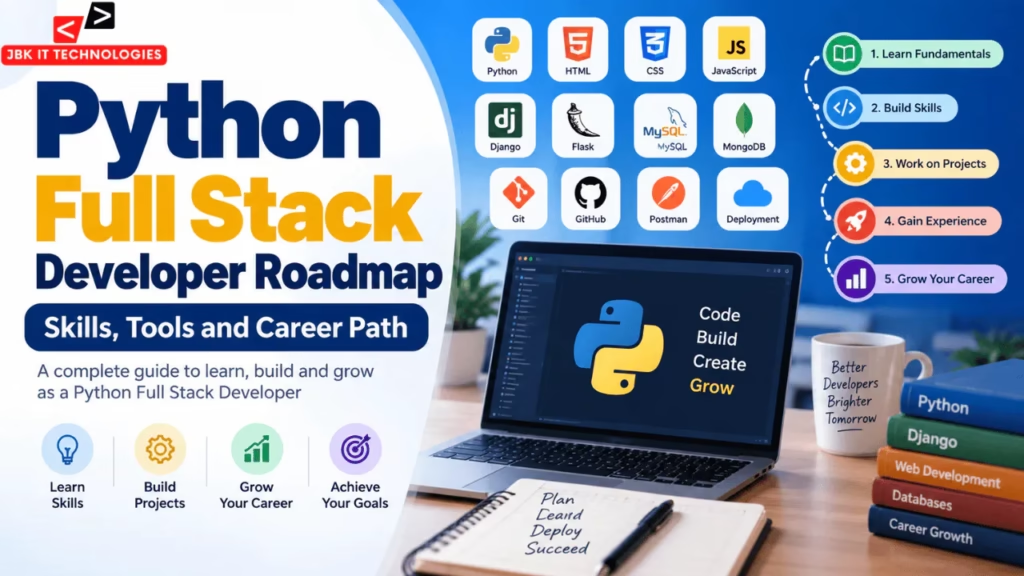
Python Full Stack Developer Roadmap
Step 1: Learn Programming Fundamentals
Before moving into web frameworks, understand the fundamentals of Python.
Start with:
- Variables
- Data types
- Operators
- Conditional statements
- Loops
- Functions
- Lists
- Tuples
- Sets
- Dictionaries
- Strings
- File handling
- Exception handling
These concepts form the foundation of Python programming.
For example, understanding loops and conditional statements helps you implement application logic, while functions help you organize reusable code.
Do not rush through these concepts.
A strong understanding of Python fundamentals makes later topics such as Django, Flask and API development easier to understand.
Step 2: Learn Object-Oriented Programming in Python
Object-Oriented Programming, commonly called OOP, is an important part of Python development.
Important concepts include:
- Classes
- Objects
- Methods
- Constructors
- Inheritance
- Encapsulation
- Polymorphism
- Abstraction
OOP helps developers structure larger applications into reusable and maintainable components.
You should be comfortable creating classes and objects before moving into more complex backend development.
Step 3: Learn Advanced Python Concepts
After learning the fundamentals, move into more advanced Python topics.
These may include:
- Modules
- Packages
- Regular expressions
- Lambda functions
- Map
- Filter
- Reduce
- JSON
- Virtual environments
- Package management
- Working with Python libraries
Python libraries can also be introduced depending on the development path.
For example, JBK IT Technologies’ published Python Full Stack curriculum includes topics such as modules and packages, regular expressions, lambda/map/filter/reduce, NumPy and Pandas basics, and JSON.
The goal at this stage is to become comfortable writing organized Python programs.
Step 4: Learn HTML
HTML is the foundation of webpages.
You should learn:
- HTML document structure
- Headings
- Paragraphs
- Links
- Images
- Lists
- Tables
- Forms
- Input elements
- Semantic HTML
- HTML5 elements
HTML creates the structure of the interface.
For example, on a registration page, HTML can define the name field, email field, password field and submit button.
A Python Full Stack Developer does not necessarily need to become a specialist UI designer, but understanding HTML is essential for working with web applications.
Step 5: Learn CSS
CSS controls the visual presentation of a webpage.
Important concepts include:
- Selectors
- Colors
- Typography
- Spacing
- Box model
- Flexbox
- Grid
- Positioning
- Responsive design
- Media queries
- Transitions
A developer should understand how to create layouts that work across desktop, tablet and mobile screens.
Responsive design is particularly important because modern applications are accessed through different screen sizes.
Step 6: Learn JavaScript
JavaScript adds interaction and dynamic behavior to webpages.
Important beginner topics include:
- Variables
- Data types
- Functions
- Arrays
- Objects
- Conditions
- Loops
- DOM
- Events
- Form validation
- Fetch/API requests
- Asynchronous programming
For a Python Full Stack Developer, JavaScript is useful for connecting the frontend with backend APIs and creating interactive user interfaces.
JBK IT Technologies’ published curriculum includes JavaScript fundamentals covering areas such as DOM, events and validations.
Step 7: Learn Bootstrap or a Frontend Framework
After learning HTML, CSS and JavaScript, you can learn tools that help create responsive interfaces more efficiently.
Bootstrap is one option for creating responsive layouts and reusable interface components.
You can also explore modern frontend frameworks such as React or Angular depending on your career direction and course curriculum.
The important point is to understand the fundamentals first.
A beginner who knows HTML, CSS and JavaScript will generally find frontend frameworks easier to understand than someone who immediately jumps into a framework without learning the basics.
Step 8: Learn Django
Django is a Python web framework used for building web applications.
It is an important technology in many Python Full Stack learning paths.
Important Django concepts include:
- Django project structure
- Applications
- URLs
- Views
- Templates
- Models
- Forms
- Validation
- Django Admin
- ORM
- Static files
- Media files
- Database integration
- Authentication
Django follows the Model-View-Template architecture.
Understanding how these components communicate helps you create structured web applications.
JBK IT Technologies’ published curriculum covers Django project architecture, MVT, models, views, templates, forms, validation, Django ORM, database integration and static/media file handling.
Step 9: Explore Flask
Flask is another Python web framework.
It is lightweight and flexible and can be useful for building web applications and APIs.
Basic Flask topics can include:
- Flask setup
- Routing
- Templates
- Jinja2
- Forms
- Sessions
- Database connectivity
JBK’s published curriculum lists Flask as an optional/advanced module alongside Django.
Learning more than one framework can help you understand different approaches to Python web development.
Step 10: Learn SQL and Databases
Web applications need databases to store information.
SQL is important because relational databases use SQL for tasks such as:
- Creating tables
- Adding records
- Updating records
- Deleting records
- Retrieving information
- Joining tables
- Filtering data
Important SQL concepts include:
- SELECT
- INSERT
- UPDATE
- DELETE
- CREATE
- ALTER
- DROP
- WHERE
- ORDER BY
- GROUP BY
- JOIN
- Primary keys
- Foreign keys
You can practice SQL using databases such as MySQL or PostgreSQL.
Understanding databases is an important part of becoming a complete full stack developer.
Step 11: Learn MongoDB
MongoDB is a NoSQL database that stores data in a document-oriented format.
A Python Full Stack Developer may encounter both relational and NoSQL databases depending on the project.
Basic MongoDB concepts include:
- Databases
- Collections
- Documents
- Queries
- CRUD operations
- Database integration
You do not necessarily need to master every database system at the beginning.
Focus first on understanding database fundamentals and then expand your knowledge.
Step 12: Learn REST APIs
APIs are an important part of modern web development.
A REST API allows applications to communicate using HTTP requests.
Common HTTP methods include:
For example:
A frontend application may send a GET request to retrieve product information from a Python backend.
A registration form may send a POST request to create a new user.
API development is therefore an important skill for a Python Full Stack Developer.
JBK IT Technologies’ published curriculum includes REST API concepts, Django REST Framework, CRUD operations, API consumption with JavaScript and API testing with Postman.
Step 13: Learn Git and GitHub
Learning Git is important for managing source code.
Git allows developers to track changes to their projects.
Important concepts include:
- Repository
- Commit
- Branch
- Merge
- Clone
- Pull
- Push
- Pull request
- Remote repository
GitHub can be used to host repositories and collaborate with other developers.
For students and freshers, a well-organized GitHub profile can also provide a place to showcase coding projects.
Step 14: Learn Debugging and Testing
Writing code is only one part of development.
You also need to understand how to identify and fix errors.
Learn how to:
- Read error messages
- Use debugging tools
- Test functions
- Validate forms
- Test APIs
- Check database queries
- Identify frontend issues
- Fix backend errors
Tools such as browser developer tools and Postman can help during development.
Step 15: Learn Deployment
Building an application locally is different from making it accessible online.
Deployment introduces concepts such as:
- Servers
- Environment variables
- Production settings
- Domain names
- Hosting
- Database configuration
- Application security
- Static files
- Logs
Depending on the technology stack, applications can be deployed using different hosting or cloud platforms.
JBK’s published Python Full Stack curriculum includes deployment topics involving platforms such as Heroku, PythonAnywhere or AWS.
The specific deployment platform you use can vary depending on the project and current platform availability.
Tools Used in Python Full Stack Development
A Python Full Stack Developer may work with a combination of programming languages, frameworks, databases and development tools.
| Area | Technologies |
|---|
| Programming | Python |
| Frontend | HTML, CSS, JavaScript |
| UI Framework | Bootstrap |
| Frontend Framework | React / Angular |
| Backend | Django, Flask |
| Database | MySQL, PostgreSQL |
| NoSQL | MongoDB |
| API | REST API, Django REST Framework |
| Version Control | Git, GitHub |
| API Testing | Postman |
| Package Management | pip |
| Development | Virtual environments |
| Deployment | Cloud/hosting platforms |
The exact technology combination can differ from one company or project to another.
Projects to Build While Learning Python Full Stack
Projects are one of the most important parts of your learning journey.
Instead of completing tutorials without building anything, try to create applications that combine multiple technologies.
1. Student Management System
Features can include:
- Student registration
- Login
- Student records
- Course information
- Search
- Update/delete functionality
Technologies:
Python + Django + HTML + CSS + JavaScript + MySQL
2. E-Commerce Website
You can create:
- Product listing
- Product details
- User registration
- Login
- Shopping cart
- Order management
- Admin panel
This project can demonstrate database operations, authentication, backend logic and frontend development.
3. Blog Application
Build a blog with:
- User registration
- Login
- Create posts
- Edit posts
- Delete posts
- Comments
- Categories
- Search
This is a useful project for understanding CRUD operations.
4. Employee Management System
Features could include:
- Employee registration
- Department management
- Employee profiles
- Search
- Update
- Delete
- Admin dashboard
5. Online Booking Application
You could build a simple booking system for:
- Classes
- Appointments
- Events
- Services
This can help you understand forms, databases, authentication and APIs.
Skills Required to Become a Python Full Stack Developer
Technical knowledge is important, but developers also benefit from strong problem-solving and communication skills.
Technical Skills
You should gradually become comfortable with:
- Python
- HTML
- CSS
- JavaScript
- Django
- Flask
- SQL
- Databases
- REST APIs
- Git
- GitHub
- Debugging
- Deployment
Problem-Solving Skills
Programming involves solving problems.
You should practice:
- Breaking large problems into smaller tasks
- Understanding requirements
- Designing solutions
- Debugging code
- Improving existing code
Communication Skills
Developers often work with designers, testers, project managers and other developers.
Clear communication can therefore be useful in professional environments.
Python Full Stack Developer Career Path
After learning the required skills and building projects, there are several possible directions.
Entry-Level Roles
Depending on your skills and experience, you may explore roles such as:
- Python Developer
- Junior Python Developer
- Backend Developer
- Full Stack Developer
- Web Developer
- Software Developer
Your actual role will depend on your technical skills, portfolio, interview performance, employer requirements and experience.
Who Can Learn Python Full Stack Development?
Python Full Stack Development can be considered by several groups.
Students
Students who are interested in software development can use full stack development as a practical learning path.
Fresh Graduates
Graduates looking to enter software development can build programming fundamentals and projects.
Non-IT Graduates
A non-IT background does not automatically prevent someone from learning programming. However, beginners may need additional time to build programming fundamentals.
Working Professionals
Professionals can learn full stack technologies to expand their technical skill set.
Career Changers
People moving from another career into software development can follow a structured roadmap starting from programming fundamentals.
Freelancers
Developers who understand frontend, backend and databases can potentially work on complete web application projects.
Python Full Stack Course in Hyderabad
or learners looking for structured classroom or online training, JBK IT Technologies offers Python Full Stack training in Dilsukhnagar, Hyderabad.
According to JBK IT Technologies’ published course information, its Python Full Stack curriculum includes Core Python, Advanced Python, frontend development, Django, Flask, databases, REST APIs, Git/GitHub and deployment. The institute also describes the training as practical and includes live projects and interview preparation.
The institute’s website currently lists both online and offline training options and identifies its Dilsukhnagar location in Hyderabad.
For students considering a Python Full Stack course in Hyderabad, comparing the curriculum, practical training, projects, trainer experience, class format and support available is useful before choosing a program.
How to Choose a Python Full Stack Course
Before enrolling in any training program, check whether the curriculum covers the complete development workflow.
Look for:
1. Python Fundamentals
The course should start with programming fundamentals.
2. Frontend Development
HTML, CSS and JavaScript should be part of the learning path.
3. Backend Framework
Django or Flask should be covered with practical examples.
4. Database Integration
You should learn how applications communicate with databases.
5. API Development
REST API concepts are important for modern web applications.
6. Version Control
Git and GitHub should be included in practical development.
7. Projects
Look for opportunities to build complete applications rather than only small coding exercises.
8. Deployment
Understanding how to move an application from development to a live environment is useful.
How Long Does It Take to Learn Python Full Stack?
There is no single learning duration that applies to everyone.
The time required depends on:
- Previous programming experience
- Number of hours spent practicing
- Learning method
- Complexity of projects
- Understanding of programming fundamentals
- Consistency
A beginner should focus on learning concepts properly rather than trying to finish the entire roadmap as quickly as possible.
For example, someone who already knows programming may move through Python fundamentals faster than someone learning programming for the first time.
JBK IT Technologies currently describes its typical Python Full Stack course duration as approximately 3 to 4 months depending on the batch format.
How to Build a Python Full Stack Portfolio
A portfolio can help demonstrate what you have actually built.
Your portfolio can include:
Project Name
Clearly mention the application name.
Project Description
Explain what the application does.
Technologies Used
For example:
Python, Django, HTML, CSS, JavaScript and MySQL.
Features
List the major features you implemented.
Screenshots
Show important application screens.
GitHub Repository
Provide the repository if it is public and properly documented.
Live Demo
If the application is deployed, provide a working demo.
A portfolio should demonstrate practical ability rather than simply listing technologies.