
Advanced Excel Interview Questions and Answers for Freshers (2026)
MS Office Course Advantages and Disadvantages Home Blogs Contact Us Lorem ipsum dolor sit amet,
Call Now : 9390612347
Call Now : 8096061003
Call Now : 9000709021
Lorem ipsum dolor sit amet, consectetur adipiscing elit. Ut elit tellus, luctus nec ullamcorper mattis, pulvinar dapibus leo.
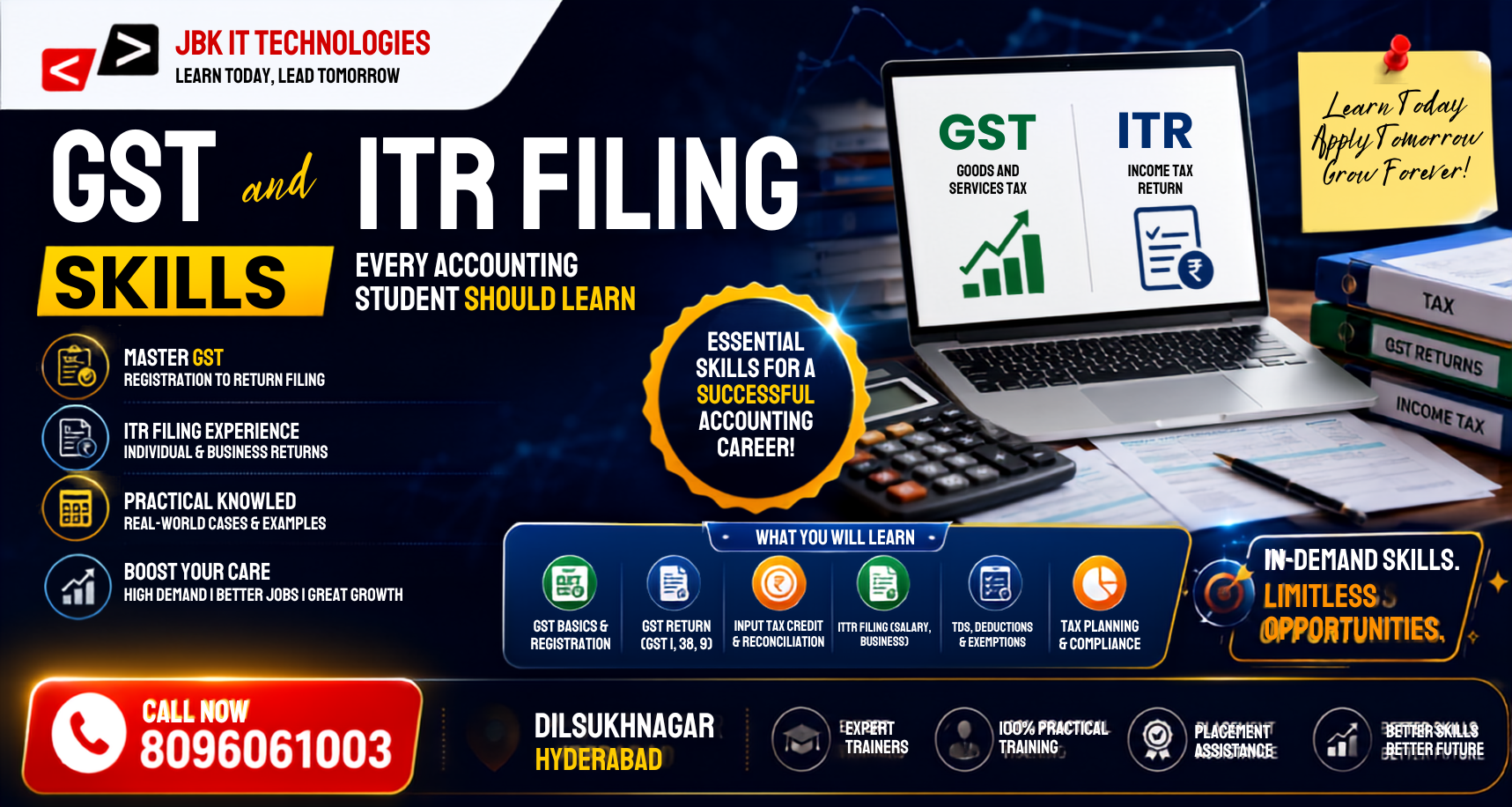
The accounting profession has undergone a significant transformation over the past decade. Employers no longer look for candidates who only understand journal entries, ledgers, and financial statements. Modern businesses need accounting professionals who can manage taxation, ensure regulatory compliance, and handle digital tax filing systems efficiently. This shift has made GST and ITR filing course has made skills some of the most valuable competencies for commerce graduates and accounting professionals.
For students who have completed B.Com or are pursuing careers in accounting and finance, learning practical taxation is no longer optional. Companies expect accountants to understand GST returns, tax calculations, input tax credit, income tax regulations, and online filing procedures. A professional GST&ITR filing course helps bridge the gap between academic learning and industry requirements by providing hands-on exposure to real taxation processes.
Whether you aspire to become an accountant, tax consultant, finance executive, or GST specialist, understanding GST and income tax filing can significantly improve your employability. In this guide, we will explore what GST and ITR filing are, how they differ, the essential skills every accounting student should develop, and why these skills are highly valued in today’s job market.
Goods and Services Tax, commonly known as GST, is India’s unified indirect tax system introduced to simplify the country’s taxation structure. Before GST, businesses had to deal with multiple taxes such as VAT, Service Tax, Excise Duty, and Entry Tax. The introduction of GST streamlined these taxes into a single framework, making compliance easier and more transparent.
GST is charged whenever goods or services are supplied. Businesses collect GST from customers and remit it to the government after adjusting eligible input tax credits. Because GST affects almost every business operation, accountants play a crucial role in ensuring accurate tax calculations, maintaining records, and filing returns within prescribed deadlines.
Today, organizations across manufacturing, retail, e-commerce, healthcare, logistics, and IT sectors rely heavily on professionals who understand GST regulations and compliance procedures. This growing demand has made GST expertise one of the most sought-after skills in the accounting field.
Income Tax Return filing, commonly referred to as ITR filing, is the process of reporting income earned during a financial year to the Income Tax Department. It involves calculating taxable income, claiming eligible deductions, determining tax liability, and submitting the relevant return form online.
ITR filing is applicable not only to salaried employees but also to freelancers, professionals, business owners, partnership firms, and companies. Filing income tax returns accurately is essential because it helps maintain legal compliance, facilitates loan approvals, supports visa applications, and enables taxpayers to claim refunds when applicable.
For accounting professionals, understanding income tax filing is an important skill because many organizations depend on accountants to prepare tax-related documents, verify deductions, compute taxes, and ensure timely submissions.
Although GST filing and ITR filing both involve taxation, they serve entirely different purposes. GST is an indirect tax imposed on the supply of goods and services, while income tax is a direct tax levied on earnings and profits.
GST returns are generally filed monthly or quarterly depending on the nature of the business and applicable regulations. These returns report sales transactions, purchases, tax collections, and input tax credits. Income tax returns, on the other hand, are usually filed annually and focus on income earned during the financial year.
Understanding this distinction is fundamental for anyone pursuing a career in accounting. A skilled accountant must be capable of managing both GST compliance and income tax reporting to meet modern business requirements.
The modern workplace demands practical expertise. While academic qualifications provide theoretical knowledge, employers often prioritize candidates who had done GST & ITR filling course can perform real world accounting tasks from day one.
Businesses regularly face compliance obligations related to GST returns, tax payments, reconciliation statements, and income tax filings. As a result, organizations prefer hiring professionals who understand taxation processes and can minimize compliance risks.
For B.Com graduates and accounting students, learning GST returns and ITR filing enhances employability by making them industry ready. These skills demonstrate practical competence and often provide an advantage during interviews and job placements.
Further more, taxation expertise opens opportunities beyond traditional accounting roles. Professionals can work as GST consultants, tax advisors, compliance officers, finance executives, and independent practitioners, creating diverse career pathways.
A successful accounting professional must develop a strong understanding of taxation concepts and practical filing procedures. One of the most important areas is learning income tax basics, including tax slabs, deductions, exemptions, and tax saving provisions. Understanding these concepts helps accountants prepare accurate income tax returns and provide valuable support to businesses and individuals.
Another critical skill involves GST registration and compliance management. Accountants must understand registration requirements, GSTIN allocation, tax invoice preparation, and record maintenance. Since GST regulations are technology driven, familiarity with online portals and digital filing systems is equally important.
Tax computation is another essential competency. Accountants should be able to calculate GST liabilities, determine input tax credits, compute taxable income, and estimate tax obligations accurately. These calculations directly impact financial reporting and business decision making.
In addition, proficiency in accounting software such as Tally Prime has become indispensable. Modern organizations use accounting software to manage transactions, generate GST reports, and prepare tax returns. Students who has joined GST & ITR filling course can integrate taxation knowledge with software skills are often preferred by employers.
Among the various GST returns, GSTR-1 and GSTR-3B are the most commonly used and widely recognized forms in the accounting profession.
GSTR-1 is primarily used to report outward supplies, meaning all sales transactions made by a registered business. It contains invoice details, customer information, taxable values, and GST amounts. Accurate preparation of GSTR-1 ensures transparency and facilitates proper tax credit claims by buyers.
GSTR-3B serves as a summary return that helps businesses declare tax liabilities and claim input tax credits. This return requires careful reconciliation of sales, purchases, and tax payments. Since errors in GSTR-3B can lead to penalties or notices, accountants must understand the filing process thoroughly.
Learning how to prepare and file these returns is a core component of any professional GST&ITR filing course and remains one of the most valuable practical skills for aspiring accountants.
Theoretical knowledge becomes truly valuable when applied in real business scenarios. Consider a retail company that generates hundreds of invoices each month. An accountant is responsible for verifying transactions, calculating GST, maintaining records, and filing returns accurately. Any mistake can affect compliance and lead to financial penalties.
Similarly, when an employee or business owner needs to file an income tax return, accountants play a vital role in gathering documents, verifying deductions, calculating tax liabilities, and ensuring accurate reporting. Their expertise helps taxpayers remain compliant while optimizing legitimate tax benefits.
These practical applications highlight why hands on taxation training is crucial for accounting students. Employers increasingly value candidates who can confidently handle real world compliance tasks rather than relying solely on theoretical understanding.
Taxation skills open the door to numerous career opportunities in the finance and accounting sector. Companies across industries require professionals who can manage tax compliance, financial reporting, and statutory obligations.
Many graduates begin their careers as Accounts Executives or GST Executives, where they gain practical exposure to financial operations and compliance management. With experience, they often progress into specialized taxation roles, finance management positions, or consultancy services.
Chartered Accountant firms, multinational corporations, retail organizations, manufacturing companies, logistics firms, and IT companies regularly recruit professionals with GST and income tax expertise. The growing complexity of tax regulations continues to create demand for skilled individuals capable of managing compliance efficiently.
For entrepreneurial minded professionals, taxation knowledge also provides opportunities to establish independent consultancy practices and serve businesses directly.
India’s taxation ecosystem has become increasingly digital, creating new opportunities for accounting professionals. Government initiatives promoting online compliance and digital reporting have accelerated the need for accountants who understand electronic filing systems and tax technology platforms.
The adoption of GST transformed how businesses manage indirect taxation, and continuous updates to tax regulations require professionals to stay informed and adaptable. Similarly, the digitization of income tax filing has increased the demand for individuals who can navigate online portals and ensure accurate submissions.
Industry experts predict continued growth in demand for taxation professionals as businesses expand and compliance requirements evolve. Accountants who combine taxation knowledge with digital accounting skills are expected to remain highly valuable in the coming years.
For accounting students and commerce graduates in Hyderabad, enrolling in a professional GST ITR filing course in Dilsukhnagar can provide a significant career advantage. Such programs focus on practical training, realtime filing procedures, GST returns, income tax calculations, Tally Prime integration, and compliance management.
Unlike traditional classroom education, professional taxation courses emphasize hands on learning through case studies, live examples, and industry-oriented projects. This practical exposure helps students build confidence and prepares them for workplace challenges.
With businesses actively seeking professionals who can manage taxation responsibilities, specialized training can enhance employability and improve career prospects for freshers and experienced candidates alike.
GST filing involves reporting business tax transactions under the Goods and Services Tax framework, while ITR filing involves reporting income and tax details to the Income Tax Department.
Yes. B.Com students already possess foundational accounting knowledge, making it easier for them to understand taxation concepts and filing procedures.
GSTR-1 is a GST return used to report sales transactions and outward supplies made by a registered business.
The accounting industry increasingly values professionals who possess practical taxation expertise alongside traditional accounting knowledge. Understanding GST returns, GSTR-1, GSTR-3B, income tax filing, tax computation, and compliance procedures has become essential for modern accountants. A professional GST&ITR filing course equips students with the skills needed to handle real-world taxation responsibilities confidently and efficiently.
For B.Com graduates, freshers, and aspiring finance professionals, investing in GST and ITR filing skills can create better career opportunities, improve employability, and establish a strong foundation for long-term professional growth. As businesses continue to prioritize compliance and digital taxation, these skills will remain among the most valuable assets for accounting professionals.
Ready to build a successful career in accounting and taxation? Enroll in a professional GST ITR Filing Course in Dilsukhnagar and gain hands-on experience in GST returns, income tax filing, Tally Prime, and taxation compliance. Learn from industry experts, work on practical projects, and become job-ready with industry-relevant skills that employers are actively seeking.
MS Office Course Advantages and Disadvantages Home Blogs Contact Us Lorem ipsum dolor sit amet,
Python vs Java: Which Course Should Beginners Choose in 2026? Home Blogs Contact Us Choosing
What Are VBA Macros and How Do They Help in Excel Automation? Home Blogs Contact
Why MS Office Skills Are Important for Freshers and Office Jobs Home Blogs Contact Us
Why SQL for Data Analytics Is One of the Most Valuable Skills for Today’s Tech
GST and ITR Filing Skills Every Accounting Student Should Learn Home Blogs Contact Us Lorem