Ameerpet Hyderabad

Call Now : 9390612347

Dilsukhnagar Hyderabad

Call Now : 8096061003

Mehdipatnam Hyderabad

Call Now : 9000709021

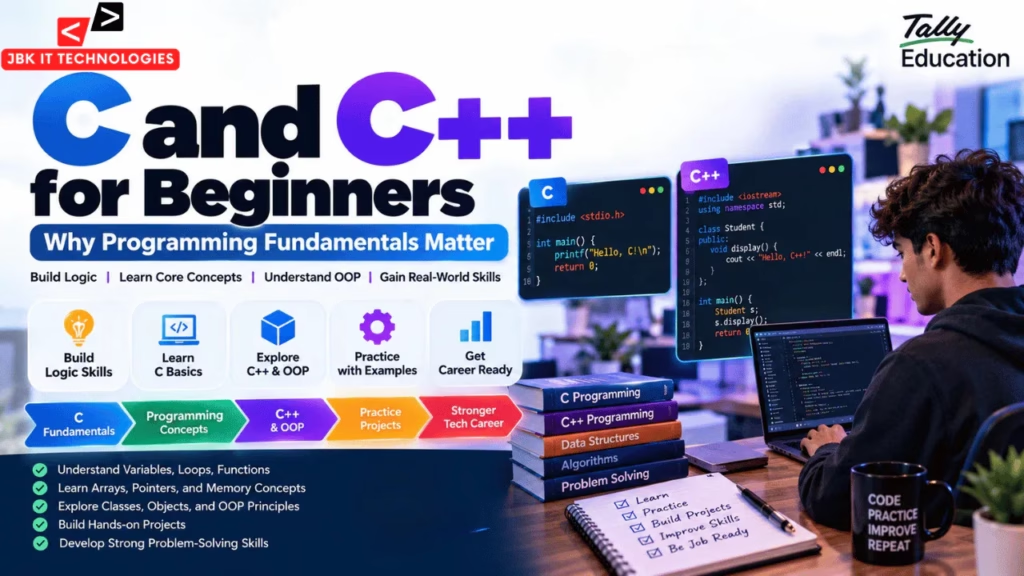
C and C++ for Beginners: Why Programming Fundamentals Matter

Learning programming is not only about memorizing syntax or writing lines of code.

For beginners, the more important goal is to understand how programs work, how problems can be broken into smaller steps, and how logical solutions can be converted into code.

This is why programming fundamentals matter.

Languages such as C and C++ can provide beginners with a strong foundation in variables, data types, operators, conditions, loops, functions, arrays, pointers, memory concepts, classes, objects, and other programming principles.

C introduces many core programming concepts through a relatively direct programming model. Its fundamentals include types, objects, expressions, functions, arrays, pointers, structures, memory-related concepts, and control statements.

C++ builds on many of these programming concepts and adds features such as classes, objects, templates, namespaces, exceptions, and other mechanisms for organizing larger programs.

For a beginner, the important question is not simply “Which language is better?”

A better question is:

“Which concepts do I need to understand to become a better programmer?”

Once you understand the fundamentals, learning other languages becomes easier because many programming ideas are transferable.

What Are Programming Fundamentals?

Programming fundamentals are the basic concepts used to create and understand computer programs.

These include:

  • Variables

  • Data types

  • Operators

  • Input and output

  • Conditional statements

  • Loops

  • Functions

  • Arrays

  • Strings

  • Pointers

  • Structures

  • Classes

  • Objects

  • Algorithms

  • Problem solving

  • Debugging

A beginner should focus on understanding why these concepts are used rather than simply memorizing their syntax.

For example, a loop is not important because you know how to write a for loop.

It is important because you understand that a loop can automate a repeated task.

Similarly, a function is not simply a block of code.

It is a way of organizing reusable logic.

This difference between memorizing syntax and understanding concepts is extremely important when learning programming.

Why Are C and C++ Important for Beginners?

C and C++ have been used for decades in software development, systems programming, embedded systems, game development, performance-oriented applications, and many other areas.

For beginners, their value is particularly related to understanding fundamental programming concepts.

C can help learners understand:

  • How variables work

  • How memory is represented

  • How functions work

  • How arrays work

  • How pointers work

  • How data is organized

  • How control flow works

C++ introduces additional programming concepts including:

  • Classes

  • Objects

  • Encapsulation

  • Inheritance

  • Polymorphism

  • Abstraction

  • Templates

  • Standard library concepts

C++ therefore gives beginners an opportunity to move from basic procedural programming toward object-oriented programming and larger software structures. C++ documentation and references cover both fundamental language concepts and object-oriented features such as classes and inheritance.


C vs C++ for Beginners

One of the most common questions beginners ask is:

Should I learn C or C++ first?

There is no single answer for everyone.

A practical learning sequence can be:

C Fundamentals → Programming Logic → Memory Concepts → C++ Fundamentals → OOP

This sequence allows a learner to first understand basic programming and then move toward object-oriented concepts.

However, beginners can also start directly with C++ if their learning path is designed around modern C++ fundamentals.

The important thing is not the order alone.

The important thing is that the learner understands the underlying concepts.


What Is C Programming?

C is a general-purpose programming language with a strong focus on fundamental programming constructs.

C programs use concepts such as:

  • Variables

  • Types

  • Expressions

  • Functions

  • Arrays

  • Pointers

  • Structures

  • Conditional statements

  • Loops

The C language reference includes core areas such as declarations, expressions, initialization, functions, statements, pointers, arrays, structures, memory management, and input/output.

For this reason, C programming for beginners can be a useful way to understand how basic programs operate.

C Programming Basics Beginners Should Learn

A beginner learning C should start with the following concepts.

1. Variables

Variables store values that a program needs to work with.

For example:

int age = 20;

Here, age represents a variable containing an integer value.

Understanding variables is one of the first steps toward understanding how programs store and manipulate information.

2. Data Types

Data types describe the type of information a variable can represent.

Common C data types include:

  • int

  • char

  • float

  • double

Understanding data types is important because different types can represent different kinds of values.

3. Operators

Operators allow programmers to perform operations.

Examples include:

  • Arithmetic operators

  • Comparison operators

  • Logical operators

  • Assignment operators

For example:

int total = price * quantity;

The multiplication operation allows the program to calculate the total.

4. Conditional Statements

Programs often need to make decisions.

For example:

if (marks >= 40)
{
    printf("Pass");
}
else
{
    printf("Fail");
}

This teaches an important programming principle:

If something happens, perform one action; otherwise, perform another.

Learning conditional logic is important for programming problem solving.

5. Loops

Loops allow programs to repeat instructions.

Common loops include:

  • for

  • while

  • do-while

For example:

for(int i = 1; i <= 5; i++)
{
    printf("%d\n", i);
}

Instead of writing the same instruction five times, a loop handles the repetition.

This is one of the first places where beginners start understanding the power of programming.

6. Functions

Functions help divide a program into smaller, reusable sections.

For example:

int add(int a, int b)
{
    return a + b;
}

The function can then be called whenever the program needs to add two values.

Functions help improve:

  • Code organization

  • Reusability

  • Readability

  • Maintenance

7. Arrays

An array can store multiple values of the same type.

For example:

int marks[5] = {70, 80, 65, 90, 75};

Arrays are important because real applications frequently work with collections of values.

8. Pointers

Pointers are one of the concepts that make C particularly valuable for understanding memory-related programming.

A pointer stores an address associated with an object.

For example:

int number = 10;
int *ptr = &number;

Beginners may initially find pointers difficult.

However, understanding pointers can help build a stronger understanding of:

  • Memory

  • Addresses

  • References

  • Arrays

  • Dynamic memory

  • Data structures

The C language reference specifically includes pointers, object representation, storage duration, and memory-related concepts.

What Is C++ Programming?

C++ is a general-purpose programming language that supports multiple programming styles, including procedural and object-oriented programming.

It includes fundamental concepts such as:

  • Variables

  • Functions

  • Control flow

  • Arrays

  • References

  • Classes

  • Objects

  • Templates

  • Exceptions

  • Namespaces

  • Standard library facilities

C++ also supports object-oriented programming through classes and related mechanisms.

This makes C++ programming for beginners a useful next step after learning fundamental programming concepts.

C++ Basics Beginners Should Learn

Many basic concepts are familiar from C.

For example:

int age = 21;

The goal is to become comfortable with storing and manipulating information

Functions in C++

Functions are also an important part of C++.

int multiply(int a, int b)
{
    return a * b;
}

Functions help divide complex problems into smaller units.

This is an important part of logic building.

What Is Object-Oriented Programming?

Object-oriented programming, commonly called OOP, is a programming approach based around objects and classes.

C++ provides classes as a mechanism for creating user-defined types and organizing data and behavior.

For beginners, the four commonly discussed OOP concepts are:

  1. Encapsulation

  2. Inheritance

  3. Polymorphism

  4. Abstraction

Understanding these concepts is important for moving from simple programs toward larger application structures.

What Is a Class?

A class can be thought of as a blueprint for creating objects.

For example:

class Student
{
public:
    string name;

    void display()
    {
        cout << name;
    }
};

An object can then be created from that class.

Student student1;

The object represents an instance of the class.

This helps programmers organize related data and behavior.


What Is an Object?

An object is an instance of a class.

For example, if Student is a class:

Student student1;
Student student2;
Student student3;

Each object can represent a different student.

The concept becomes particularly useful when programs need to represent real-world entities.

For example:

  • Student

  • Employee

  • Product

  • Customer

  • Bank Account

  • Vehicle

Each can potentially be represented as a class.


Encapsulation

Encapsulation means organizing data and the operations that work with that data together while controlling access to the internal details.

For example, a banking application could have a BankAccount class with functions for:

  • Deposit

  • Withdrawal

  • Balance checking

The user of the class doesn’t necessarily need to know how every internal operation is implemented.


Inheritance

Inheritance allows a class to derive characteristics and behavior from another class.

For example:

Vehicle
   ↓
Car

A Car can inherit common characteristics from Vehicle while adding its own behavior.

Inheritance is useful for representing relationships between different types of objects.


Polymorphism

Polymorphism allows the same interface or operation to work in different ways depending on the object or context.

This becomes useful when designing flexible applications.

Beginners do not need to master advanced polymorphism immediately.

First understand:

  • Classes

  • Objects

  • Functions

  • Inheritance

Then gradually move toward more advanced OOP concepts.


Abstraction

Abstraction means focusing on the important functionality while hiding unnecessary implementation details.

For example, when using an ATM, a user interacts with options such as:

  • Withdraw

  • Deposit

  • Check balance

The user does not need to understand the internal banking software implementation.

Programming uses similar ideas to simplify complex systems.

How C Helps Build Programming Logic

One major reason beginners study C is that it encourages them to think carefully about how a program works.

Suppose you need to find the largest number in an array.

Instead of immediately searching for a ready-made solution, you can think through the problem:

  1. Start with the first number.

  2. Treat it as the largest.

  3. Compare it with the next number.

  4. Replace the largest value if necessary.

  5. Continue until the array ends.

  6. Display the result.

This process is logic building.

The language is simply the tool used to implement the solution.

Why Logic Building Matters

After learning accounting basics, become familiar with the TallyPrime interface.

Learn how to:

  • Open the software
  • Navigate menus
  • Search options
  • Create companies
  • Access reports
  • Configure company features
  • Enter transactions
  • View ledgers

TallyPrime’s current interface includes navigation and search functionality designed to help users access features and reports.

A beginner should spend time practicing navigation before moving into complex transactions.

C and C++ Practice Exercises for Beginners

Beginners should not learn programming only through theory.

Practice is essential.

Start with small exercises.

Beginner C Exercises

Try creating programs to:

  • Print “Hello World”

  • Add two numbers

  • Find the largest of two numbers

  • Check whether a number is even or odd

  • Calculate factorial

  • Generate multiplication tables

  • Reverse a number

  • Check whether a number is prime

  • Find the largest value in an array

  • Calculate the average of numbers


Intermediate C Exercises

Once the basics are comfortable, try:

  • Student marks management

  • Simple calculator

  • Number guessing game

  • Employee record system

  • Bank account simulation

  • Inventory management

  • Simple menu-driven applications

These projects help connect individual programming concepts.

Beginner C++ Projects

After learning C++ basics and OOP, try creating:

Student Management System

Features:

  • Add student

  • Display student

  • Search student

  • Update student

  • Delete student

Bank Account Program

Features:

  • Create account

  • Deposit

  • Withdraw

  • Check balance

Library Management System

Features:

  • Add books

  • Search books

  • Issue books

  • Return books

These projects help beginners practice classes, objects, functions, conditions, loops, and data

C and C++ Learning Roadmap

A beginner-friendly roadmap can look like this:

Programming Basics
       ↓
C Syntax
       ↓
Variables & Data Types
       ↓
Conditions
       ↓
Loops
       ↓
Functions
       ↓
Arrays & Strings
       ↓
Pointers
       ↓
Structures
       ↓
C++ Basics
       ↓
Classes & Objects
       ↓
Encapsulation
       ↓
Inheritance
       ↓
Polymorphism
       ↓
Data Structures
       ↓
Projects

This sequence gives beginners a structured way to progress.

Should Beginners Learn C or C++ First?

here are two reasonable approaches.

Approach 1: C First

Learn:

C → Programming Fundamentals → Memory → C++ → OOP

This approach can be useful for students who want to understand lower-level programming concepts before moving into object-oriented programming.

Approach 2: C++ Directly

Start with:

C++ → Programming Basics → OOP → Data Structures → Projects

This approach can also work if the curriculum teaches programming fundamentals clearly before introducing advanced C++ features.

Therefore, the answer to “Should beginners learn C or C++ first?” depends on the learner’s goals and learning method.

The important thing is not simply which language comes first.

The important thing is developing a strong understanding of programming fundamentals.

C vs C++: Key Differences

FeatureCC++
Programming styleProceduralMulti-paradigm
ClassesNoYes
ObjectsNo class-based objectsYes
OOPNot class-based OOPStrong OOP support
PointersYesYes
FunctionsYesYes
StructuresYesYes
TemplatesNoYes
Exception handlingLimited language-level facilitiesYes
Standard libraryC standard libraryC++ standard library

C focuses strongly on fundamental procedural programming constructs, while C++ adds mechanisms for object-oriented and other programming styles.

Step 8: Learn GST in Tally Prime

GST is an important topic for learners studying accounting in India.

TallyPrime allows businesses to configure GST information and record GST-compliant transactions. Tally’s current documentation explains that GST setup involves company registration details, GST rates and other relevant master information.

A beginner’s GST module can cover:

  • GST basics
  • GST registration details
  • GST rates
  • HSN/SAC
  • CGST
  • SGST
  • IGST
  • Input Tax Credit
  • GST sales
  • GST purchases
  • GST reports
  • GST reconciliation

Students should learn the accounting treatment as well as the software workflow.

GST rules and filing requirements can change, so learners should always verify current requirements from official government or professional sources when performing actual compliance work.

Why Programming Fundamentals Matter for Future Developers

Learning a programming language is only the beginning.

Strong fundamentals can help when learning other technologies later.

For example:

C/C++ Fundamentals

↓

Data Structures

↓

Algorithms

↓

Java / Python / JavaScript

↓

Web / Software / Application Development

The syntax may change between languages, but concepts such as:

  • Variables

  • Conditions

  • Loops

  • Functions

  • Data structures

  • Algorithms

  • Problem solving

continue to appear in different forms.

This is why programming fundamentals for students are important even when their future career may involve a different programming language.

C and C++ for Students

Students studying computer science, engineering, information technology, or related disciplines can benefit from learning programming fundamentals early.

C and C++ can provide practice in:

  • Logical thinking

  • Problem solving

  • Coding

  • Algorithms

  • Data structures

  • Memory concepts

  • Object-oriented programming

The goal should not be to simply complete a syllabus.

Students should try to understand how individual concepts connect.

For example:

Variables

→ store information

Conditions

→ make decisions

Loops

→ repeat operations

Functions

→ organize logic

Arrays

→ store collections

Pointers

→ work with memory and addresses

Classes

→ organize data and behavior

Once these connections become clear, programming becomes easier to understand.

Common Mistakes C and C++ Beginners Make

1. Memorizing Code

Copying code without understanding it creates problems later.

Always ask:

Why does this code work?


2. Avoiding Errors

Errors are part of programming.

Instead of being afraid of compiler errors, learn how to read them.


3. Practicing Too Little

Watching tutorials is not enough.

Write code regularly.


4. Jumping to Advanced Topics

Beginners sometimes try to learn advanced OOP, templates, frameworks, or complex projects before understanding loops and functions.

Build the foundation first.


5. Ignoring Logic

Programming is problem solving.

Don’t focus only on syntax.


6. Copying Projects

A project copied completely from a tutorial may not demonstrate your actual understanding.

After completing a tutorial, modify the project.

Add your own features.

How to Practice C and C++

A good practice routine can be:

Step 1

Learn one concept.

Step 2

Write a small example.

Step 3

Change the example.

Step 4

Solve a problem without looking at the solution.

Step 5

Build a small project.

For example:

Learn loops

↓

Print numbers

↓

Print even numbers

↓

Create multiplication table

↓

Create pattern programs

↓

Build a number-based mini project

This gradually increases problem-solving ability.

C Programming Course in Dilsukhnagar

Students searching for a C programming course in Dilsukhnagar should look for a learning path that covers more than basic syntax.

A useful beginner curriculum should include:

  • C fundamentals

  • Variables

  • Data types

  • Operators

  • Conditions

  • Loops

  • Functions

  • Arrays

  • Strings

  • Pointers

  • Structures

  • Problem-solving exercises

  • Practical projects

The focus should be on understanding programming logic and applying concepts through practice.


C++ Course in Hyderabad

For learners looking for a C++ course in Hyderabad, it is useful to compare curricula based on the depth of programming fundamentals and practical work.

A good C++ learning path can include:

  • C++ syntax

  • Variables and data types

  • Functions

  • Arrays

  • Strings

  • Classes

  • Objects

  • Constructors

  • Encapsulation

  • Inheritance

  • Polymorphism

  • Abstraction

  • Templates

  • Exception handling

  • Data structures

  • Projects

The exact syllabus can vary depending on the learner’s level and goals.

Frequently Asked Questions

Should beginners learn C or C++ first?

Beginners can learn C first to understand fundamental programming and memory concepts, then move to C++ for object-oriented programming. However, beginners can also start directly with C++ if the course provides a strong fundamentals-first approach.

Is C difficult for beginners?

C can initially seem challenging because it exposes learners to concepts such as pointers and memory. However, learning the language step by step can make these concepts easier to understand.

Is C++ good for beginners?

Yes. C++ can be used to learn programming fundamentals and object-oriented programming. Beginners should start with basic concepts before moving to advanced C++ features.

What should I learn first in C?

Start with:

  • Variables

  • Data types

  • Operators

  • Input/output

  • Conditions

  • Loops

  • Functions

Then move to arrays, strings, pointers, structures, and other concepts.

What should I learn first in C++?

Start with programming fundamentals, then learn C++ syntax, functions, arrays, strings, classes, objects, and basic OOP concepts.

Why are C and C++ useful for programming fundamentals?

They expose learners to important concepts such as variables, control flow, functions, memory, data structures, and object-oriented programming.

Is C necessary before C++?

No. C is not strictly required before C++. However, learning C fundamentals first can provide useful background for understanding certain low-level concepts.

What is OOP in C++?

OOP stands for Object-Oriented Programming. C++ supports OOP concepts including classes, objects, encapsulation, inheritance, polymorphism, and abstraction.

Can I learn C and C++ without a programming background?

Yes. Beginners can start from basic programming concepts and gradually progress through exercises and projects.

What projects can beginners create with C?

Beginners can create:

  • Calculator

  • Student management system

  • Number guessing game

  • Employee management system

  • Simple banking program

  • Inventory management program

What projects can beginners create with C++?

Beginners can create:

  • Student management system

  • Library management system

  • Bank account application

  • Inventory management system

  • Quiz application

  • Simple billing system

Enquiry Form