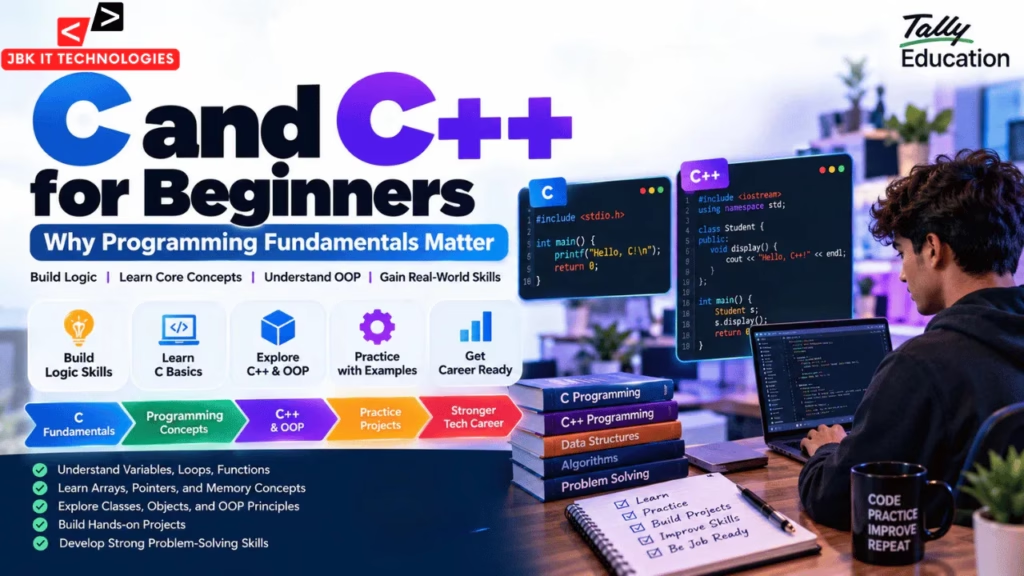
Object-oriented programming, commonly called OOP, is a programming approach based around objects and classes.
C++ provides classes as a mechanism for creating user-defined types and organizing data and behavior.
For beginners, the four commonly discussed OOP concepts are:
Encapsulation
Inheritance
Polymorphism
Abstraction
Understanding these concepts is important for moving from simple programs toward larger application structures.
What Is a Class?
A class can be thought of as a blueprint for creating objects.
For example:
class Student
{
public:
    string name;

    void display()
    {
        cout << name;
    }
};
An object can then be created from that class.
Student student1;
The object represents an instance of the class.
This helps programmers organize related data and behavior.
What Is an Object?
An object is an instance of a class.
For example, if Student is a class:
Student student1;
Student student2;
Student student3;
Each object can represent a different student.
The concept becomes particularly useful when programs need to represent real-world entities.
For example:
Student
Employee
Product
Customer
Bank Account
Vehicle
Each can potentially be represented as a class.
Encapsulation
Encapsulation means organizing data and the operations that work with that data together while controlling access to the internal details.
For example, a banking application could have a BankAccount class with functions for:
Deposit
Withdrawal
Balance checking
The user of the class doesn’t necessarily need to know how every internal operation is implemented.
Inheritance
Inheritance allows a class to derive characteristics and behavior from another class.
For example:
Vehicle
   ↓
Car
A Car can inherit common characteristics from Vehicle while adding its own behavior.
Inheritance is useful for representing relationships between different types of objects.
Polymorphism
Polymorphism allows the same interface or operation to work in different ways depending on the object or context.
This becomes useful when designing flexible applications.
Beginners do not need to master advanced polymorphism immediately.
First understand:
Classes
Objects
Functions
Inheritance
Then gradually move toward more advanced OOP concepts.
Abstraction
Abstraction means focusing on the important functionality while hiding unnecessary implementation details.
For example, when using an ATM, a user interacts with options such as:
Withdraw
Deposit
Check balance
The user does not need to understand the internal banking software implementation.
Programming uses similar ideas to simplify complex systems.