Ameerpet Hyderabad

Call Now : 9390612347

Dilsukhnagar Hyderabad

Call Now : 8096061003

Mehdipatnam Hyderabad

Call Now : 9000709021

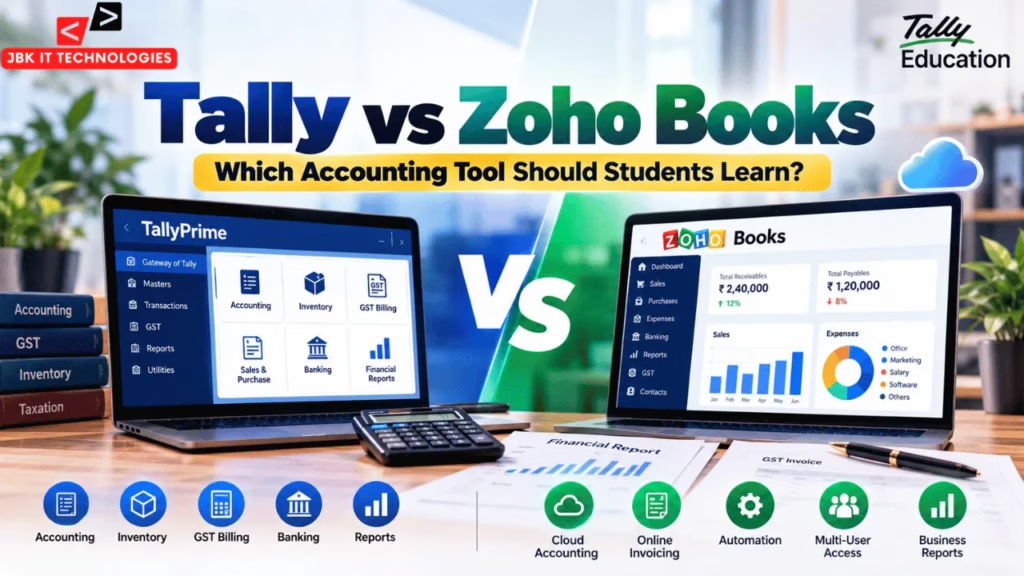
Tally vs Zoho Books: Which Accounting Tool Should Students Learn?

Choosing accounting software is an important decision for students who want to build a career in accounting, finance, taxation, bookkeeping, or business operations.

Two names that beginners are likely to encounter are TallyPrime and Zoho Books.

Both can be used for accounting-related activities, invoicing, taxation, reporting, and business financial management. However, they have different strengths and workflows.

This leads to a common question:

Tally vs Zoho Books — which one should students learn first?

The answer depends on the student’s career goals.

TallyPrime is widely associated with accounting, inventory, business transactions, taxation, banking, and financial reporting. Tally’s current documentation describes TallyPrime as supporting accounting, inventory, banking, payroll, taxation, reporting, and related business operations. TallyHelp

Zoho Books is a cloud-oriented accounting platform with features covering invoicing, expenses, banking, GST compliance, inventory, reporting, automation, collaboration, and online financial workflows. Zoho

This doesn’t necessarily mean that students have to choose only one.

In fact, learning both Tally and Zoho Books can provide a broader understanding of modern accounting software.

The better approach is to understand what each platform does, where it is commonly useful, and which one fits your learning objectives.

Tally vs Zoho Books: Quick Comparison

Before going into the details, here is a simple comparison.

FeatureTallyPrimeZoho Books
AccountingStrongStrong
GST accountingYesYes
GST billingYesYes
InvoicingYesYes
InventoryStrongAvailable
BankingYesYes
Financial reportsYesYes
Cloud capabilitiesAvailable through Tally’s cloud offeringsCore cloud-oriented workflow
Online collaborationAvailable depending on setupStrong
AutomationAvailableStrong
Mobile accessAvailable through supported optionsWeb and mobile access
Small business useStrongStrong
Traditional accounting workflowsStrongStrong
Online invoicingYesStrong
Learning value for accounting studentsHighHigh

The comparison is not about declaring one software universally better.

Instead, it is about understanding which tool is better suited to a particular accounting workflow.

What Is TallyPrime?

TallyPrime is accounting and business-management software used for activities such as accounting, inventory management, sales, purchases, banking, taxation, and reporting.

Tally’s documentation lists accounting, inventory, banking utilities, sales, purchases, payroll, taxation, analysis, and cloud access among its capabilities. TallyHelp

For accounting students, TallyPrime can provide practical exposure to concepts such as:

  • Company creation
  • Ledgers
  • Groups
  • Vouchers
  • Sales
  • Purchases
  • Receipts
  • Payments
  • Journal entries
  • Inventory
  • GST
  • Banking
  • Reconciliation
  • Financial reports

This makes Tally particularly relevant for students who want to understand the practical side of business accounting.

What Is Zoho Books?

Zoho Books is an online accounting platform designed to help businesses manage financial transactions and accounting workflows.

Its current feature set includes:

  • Invoicing
  • Expenses
  • Bills
  • Banking
  • Reconciliation
  • Inventory
  • GST
  • Financial reports
  • Automation
  • Customer management
  • Vendor management
  • Collaboration
  • Online payments

Zoho Books also supports GST workflows in India, including GST-compliant invoices, e-way bills, e-invoicing, GST reports, and direct GST-related workflows. Zoho

Its cloud-oriented approach makes it particularly relevant to businesses that want to manage accounting through online systems and connected financial workflows.

Why Should Accounting Students Learn Accounting Software?

Accounting theory is important.

However, employers often expect accounting professionals to understand how financial transactions are actually recorded and managed using software.

For example, knowing the accounting concept of a sale is different from knowing how to:

  • Create a customer
  • Create a ledger
  • Enter a sales invoice
  • Apply GST
  • Record a receipt
  • Track outstanding payments
  • Reconcile bank transactions
  • Generate reports

Accounting software helps connect theoretical accounting concepts with practical business workflows.

This is why students should consider learning at least one major accounting platform.

TallyPrime Use Cases

TallyPrime course in hyderabad  can be useful in several accounting and business scenarios.

1. Accounting

TallyPrime supports accounting transactions and financial reporting.

Its accounting functionality includes chart of accounts, journal entries, vouchers, banking transactions, and financial reports. TallyHelp

Students can practice:

  • Sales entries
  • Purchase entries
  • Receipt entries
  • Payment entries
  • Contra entries
  • Journal entries

2. GST Accounting

GST is an important area for accounting professionals working in India.

Students learning Tally can practice concepts related to:

  • GST ledgers
  • Taxable sales
  • Purchases
  • Input tax
  • Output tax
  • GST invoices
  • Tax reports

The objective should not be simply learning which button to click.

Students should understand the accounting logic behind the transaction.

For example:

Sale → Customer → Sales Ledger → GST → Invoice → Receivable

Understanding this flow is more valuable than memorizing screens.

3. Inventory Management

TallyPrime has extensive inventory-management capabilities.

Tally’s current inventory documentation includes stock groups, categories, batches, locations/godowns, multiple units of measure, stock reports, and manufacturing-related workflows. Tally Solutions

This can be particularly useful for businesses that:

  • Buy products
  • Store products
  • Sell products
  • Track stock
  • Manage multiple locations
  • Monitor inventory costs

For students, inventory accounting provides a practical understanding of how physical goods connect with financial records.

4. Banking and Reconciliation

Accounting software is also used to track banking transactions.

TallyPrime supports banking-related transactions and reconciliation workflows. TallyHelp

Students can learn how to:

  • Record payments
  • Record receipts
  • Track bank balances
  • Compare book records with bank statements
  • Identify differences
  • Reconcile transactions

These are practical skills used in accounting departments.

5. Financial Reporting

TallyPrime can generate financial reports that help businesses understand their financial position.

Examples include:

  • Profit and Loss
  • Balance Sheet
  • Trial Balance
  • Outstanding reports
  • Stock reports
  • Sales reports
  • Purchase reports

Learning how to interpret reports is just as important as learning how to generate them.

Zoho Books Use Cases

Zoho Books is designed around a more connected online accounting workflow.

1. Online Invoicing

Zoho Books allows businesses to create and send invoices, manage payments, and handle different sales transactions.

Its current India documentation includes quotes, sales orders, invoices, recurring invoices, retainer invoices, and credit notes. Zoho

For students, this provides exposure to a digital invoicing workflow.

2. Cloud Accounting

One of the major differences beginners notice is the online nature of Zoho Books.

Cloud accounting allows financial information and accounting workflows to be accessed through supported online platforms rather than relying only on a traditional local setup.

Zoho Books supports accounting access through web and mobile experiences and provides collaboration capabilities for businesses and accounting teams. Zoho

This can be useful for businesses with:

  • Remote employees
  • Multiple users
  • Distributed teams
  • Online operations
  • External accountants

3. GST Billing

Zoho Books has strong GST-related capabilities in its Indian edition.

Its current GST features include:

  • GST-compliant invoices
  • HSN/SAC codes
  • GST calculations
  • GST reports
  • E-way bills
  • E-invoicing
  • GST filing workflows
  • GST reconciliation

Zoho Books states that it can compile taxable transactions, support GST return workflows, and generate e-way bills and e-invoices. Zoho

This makes Zoho Books relevant for students who want to understand GST billing in cloud accounting.

4. Bank Reconciliation

Zoho Books can connect banking information and help users categorize and reconcile transactions.

Its current accounting features include bank feeds, transaction categorization, and reconciliation workflows. Zoho

This is useful for understanding how accounting records can be connected with actual banking activity.

5. Automation

Automation is another important area.

Zoho Books provides features for automating tasks such as:

  • Payment reminders
  • Recurring invoices
  • Transaction workflows
  • Notifications
  • Categorization
  • Approval processes

Its current feature set also includes AI-related capabilities such as anomaly detection and conversational assistance. Zoho

For students, this introduces the idea that modern accounting is increasingly about process automation, not just manual transaction entry.

Tally vs Zoho Books for GST Billing

GST is one of the most important areas when comparing the two platforms.

Both TallyPrime and Zoho Books can be used for GST-related accounting workflows.

However, the learning experience can differ.

TallyPrime

Students can focus on:

  • GST ledgers
  • GST sales
  • GST purchases
  • Tax calculations
  • GST reports
  • Accounting entries
  • Inventory and GST integration

Zoho Books

Students can focus on:

  • GST-compliant invoices
  • HSN/SAC
  • GST transaction handling
  • GST reports
  • E-way bills
  • E-invoicing
  • GST reconciliation

Zoho Books currently provides GST and e-invoicing functionality integrated into its accounting workflow. Zoho

The important point is that software should not replace knowledge of GST concepts.

A student should understand:

Taxable Value

→

GST Rate

→

CGST / SGST / IGST

→

Invoice

→

Accounting Entry

→

Reporting

Software simply helps implement the process.

Tally vs Zoho Books for Inventory

Inventory is another area where the two platforms can be compared.

TallyPrime has extensive inventory functionality, including stock groups, categories, batches, locations, multiple units, manufacturing-related processes, and inventory reports. Tally Solutions

Zoho Books also provides inventory features, particularly within its connected online accounting environment. Its current plans include inventory tracking along with sales and purchase order management. 

If a student’s goal involves businesses with complex inventory operations, understanding Tally’s inventory workflow can be particularly valuable.

However, learning Zoho Books provides useful exposure to how inventory connects with cloud-based invoicing, purchasing, sales, and financial reporting.

Tally vs Zoho Books for Cloud Accounting

This is one of the areas where the distinction becomes more visible.

Zoho Books was designed as an online accounting platform, with web, mobile, banking, collaboration, automation, and connected-business features. Zoho

Tally also provides cloud-oriented options. Tally’s current cloud accounting information highlights remote access, collaboration, GST, invoicing, reporting, and multi-user workflows. Tally Solutions

Therefore, it is no longer accurate to think of the comparison simply as:

Tally = offline

Zoho Books = online

The actual comparison depends on the specific setup, product version, hosting model, business requirements, and workflow.

For students, the more useful lesson is to understand both traditional accounting workflows and modern cloud accounting workflows.

Tally vs Zoho Books: Which Is Easier for Beginners?

Ease of learning depends on the learner’s background.

A student who already understands accounting concepts may find transaction-based accounting software easier to learn.

A beginner with no accounting background may need to first understand:

  • Debit
  • Credit
  • Assets
  • Liabilities
  • Income
  • Expenses
  • Capital
  • Journal entries
  • Ledgers

Then the software becomes easier to understand.

Instead of asking:

“Which software is easiest?”

Ask:

“Which accounting concepts do I need to understand first?”

Once the accounting foundation is clear, learning Tally or Zoho Books becomes significantly easier.

Tally vs Zoho Books for Accounting Students

For students, both tools have learning value.

Tally can help students understand:

  • Traditional accounting workflows
  • Ledgers
  • Vouchers
  • Inventory
  • GST
  • Banking
  • Financial reports

Zoho Books can help students understand:

  • Cloud accounting
  • Online invoicing
  • Digital workflows
  • Banking integration
  • Automation
  • Collaboration
  • GST compliance
  • Online reporting

Therefore, learning both gives students exposure to different styles of accounting software.

Which Should Students Learn First?

A practical learning order can be:

Step 1 — Accounting Fundamentals

Learn:

  • Debit and credit
  • Journal
  • Ledger
  • Trial balance
  • Profit and loss
  • Balance sheet
  • GST basics

↓

Step 2 — TallyPrime

Learn:

  • Company setup
  • Ledgers
  • Groups
  • Vouchers
  • Sales
  • Purchases
  • Inventory
  • GST
  • Banking
  • Reports

↓

Step 3 — Zoho Books

Learn:

  • Organization setup
  • Customers
  • Vendors
  • Items
  • Invoices
  • Bills
  • Expenses
  • Banking
  • GST
  • Reports
  • Automation

↓

Step 4 — Practical Projects

Create realistic business scenarios.

↓

Step 5 — Job Preparation

Practice accounting transactions, GST scenarios, reconciliation, reporting, and interview questions.

This sequence can give beginners a structured path without trying to learn everything simultaneously.

Should Students Learn Both Tally and Zoho Books?

For students interested in accounting careers, learning both can be beneficial.

The reason is simple:

Different businesses use different software.

One company may use TallyPrime.

Another may use Zoho Books.

Another may use ERP software.

Another may use a combination of accounting, payroll, CRM, inventory, and business-management tools.

A student who understands accounting principles and can adapt to different software environments may have greater flexibility.

The goal should therefore be:

Accounting knowledge + Software skills + GST knowledge + Practical experience

rather than:

Software knowledge alone

Tally vs Zoho Books for Job Relevance

Students often ask:

Which software will help me get a job?

The answer depends on the job role and employer.

Possible roles include:

  • Junior Accountant
  • Accounts Executive
  • Accounts Assistant
  • Billing Executive
  • GST Executive
  • Bookkeeper
  • Finance Assistant
  • MIS Executive
  • Accounts Payable Executive
  • Accounts Receivable Executive

The software requirement can differ between companies.

For example, an accounting position may require Tally and GST knowledge.

A modern small-business accounting position may require cloud accounting, online invoicing, banking reconciliation, and digital reporting.

Therefore, rather than learning software in isolation, students should build a wider skill set.

What Skills Should You Learn Along With Tally and Zoho Books?

Accounting software is only one part of the skill set.

Students should also consider learning:

Accounting

  • Journal entries
  • Ledger accounting
  • Trial balance
  • Profit and loss
  • Balance sheet

GST

  • GST basics
  • CGST
  • SGST
  • IGST
  • Input Tax Credit
  • GST invoices
  • E-invoicing
  • E-way bills

Excel

Learn:

  • Formulas
  • Lookup functions
  • Pivot Tables
  • Data cleaning
  • Reports

Banking

Learn:

  • Bank reconciliation
  • Payment entries
  • Receipt entries
  • Bank statements

Reporting

Learn how to interpret:

  • Profit
  • Expenses
  • Receivables
  • Payables
  • Cash flow
  • Outstanding balances

This combination is more useful for job preparation than learning only the software interface.

Practical Example: Retail Business

Imagine a small retail business in Hyderabad.

The business:

  • Purchases products from suppliers
  • Stores products
  • Sells products to customers
  • Charges GST
  • Receives payments
  • Pays suppliers
  • Maintains bank accounts

The accounting workflow might look like:

Purchase

↓

Inventory Update

↓

Supplier Payable

↓

Sales

↓

GST Calculation

↓

Customer Receivable

↓

Payment

↓

Bank Reconciliation

↓

Financial Reports

A student who understands this complete workflow can adapt more easily to different accounting software.

The software may change.

The accounting logic remains important.

Example: Tally Learning Project

Create a fictional business called:

Venu Traders

Enter:

  • Company details
  • Capital
  • Customers
  • Suppliers
  • Products
  • Purchase transactions
  • Sales transactions
  • GST
  • Receipts
  • Payments
  • Bank transactions

Then generate:

  • Trial Balance
  • Profit & Loss
  • Balance Sheet
  • Stock Summary
  • Outstanding Reports

This project can help a beginner understand the relationship between individual transactions and financial reports.

Example: Zoho Books Learning Project

Create a fictional online business.

Set up:

  • Organization
  • Customers
  • Vendors
  • Products
  • GST settings
  • Sales invoices
  • Purchase bills
  • Expenses
  • Bank account
  • Payment transactions

Then practice:

  • Bank reconciliation
  • GST reports
  • Customer outstanding
  • Vendor outstanding
  • Financial reports
  • Recurring invoices
  • Payment reminders

This introduces students to a more connected cloud-accounting workflow.

Common Mistakes When Learning Accounting Software

Mistake 1: Learning Only the Buttons

Knowing where to click isn’t enough.

Understand the accounting concept behind the transaction.

Mistake 2: Ignoring GST

For Indian accounting roles, GST knowledge can be important.

Don’t treat GST as just a software setting.

Understand the tax concepts.

Mistake 3: Skipping Accounting Fundamentals

Software cannot replace knowledge of debit, credit, assets, liabilities, income, and expenses.


Mistake 4: Learning Without Practice

Create a fictional company and enter realistic transactions.

Mistake 5: Learning Only One Software

If your goal is a flexible accounting career, exposure to multiple accounting platforms can be useful.

Accounting Software Course in Hyderabad

Students searching for an accounting software course in Hyderabad should look beyond the number of software names listed in a syllabus.

A useful curriculum should connect:

Accounting Fundamentals

  •  

TallyPrime

  •  

GST

  •  

Excel

  •  

Zoho Books

  •  

Practical Transactions

  •  

Financial Reporting

The objective should be to understand how a business transaction moves from an invoice or payment into the accounting records and ultimately into financial reports.

Tally and Zoho Books Training in Dilsukhnagar

Students looking for Tally and Zoho Books training in Dilsukhnagar can compare programs based on practical exposure rather than only course duration.

Before selecting a course, check whether students get practice with:

  • Company creation
  • Ledger creation
  • Sales
  • Purchases
  • GST
  • Inventory
  • Banking
  • Reconciliation
  • Invoicing
  • Cloud accounting
  • Financial reports
  • Practical projects

A course that combines accounting concepts with software practice can provide a stronger foundation than learning software screens without understanding the underlying accounting.

Tally vs Zoho Books: Which One Is Better?

There is no universal winner.

Tally may be a strong choice if you want to focus on:

  • Traditional accounting
  • Inventory-heavy businesses
  • GST accounting
  • Voucher-based accounting
  • Financial reporting
  • Business accounting workflows

Zoho Books may be a strong choice if you want to focus on:

  • Cloud accounting
  • Online invoicing
  • Banking integration
  • Automation
  • Collaboration
  • Digital business workflows
  • Connected accounting systems

Learning both may be the best option if:

  • You are an accounting student
  • You want broader software exposure
  • You are preparing for accounting jobs
  • You want to work with different businesses
  • You want to understand both traditional and cloud accounting

Frequently Asked Questions

Which is better to learn, Tally or Zoho Books?

Neither is universally better. Tally can be valuable for traditional accounting, inventory, GST, and business accounting workflows, while Zoho Books is particularly useful for cloud accounting, online invoicing, automation, banking integration, and connected business workflows.

Is Tally better than Zoho Books?

Tally may be a better fit for some businesses and learners, particularly those focused on accounting, inventory, GST, and established accounting workflows. The right choice depends on the business and career requirement.

Is Zoho Books better than Tally?

Zoho Books may be a better fit for businesses looking for cloud-based accounting, online collaboration, automation, online invoicing, and connected banking workflows. It is not automatically better for every business.

Should accounting students learn both Tally and Zoho Books?

Yes, learning both can be useful. It gives students exposure to different accounting workflows and can make them more adaptable when working with different businesses.

Which is better for GST billing?

Both TallyPrime and Zoho Books support GST-related accounting and billing workflows. Zoho Books currently provides GST-compliant invoicing, e-way bills, e-invoicing, GST reports, and related compliance workflows. Zoho

Is Zoho Books cloud accounting software?

Yes. Zoho Books is designed as an online accounting platform with web and mobile access, banking, collaboration, automation, invoicing, and reporting features. Zoho

Can Tally be used for inventory management?

Yes. TallyPrime provides extensive inventory-management capabilities including stock groups, categories, batches, locations, units, stock reports, and manufacturing-related features. Tally Solutions

Which one should I learn first as a beginner?

A practical sequence is to first learn accounting fundamentals, then TallyPrime, followed by Zoho Books. However, students with specific career goals can adjust this order.

Can I learn Tally without accounting knowledge?

You can learn the software interface, but understanding accounting concepts first will make Tally much easier to understand and use correctly.

Can I learn Zoho Books without accounting knowledge?

Yes, but accounting fundamentals are still important. Understanding debit, credit, assets, liabilities, income, expenses, and GST makes the software much easier to use effectively.

Is Tally useful for accounting jobs?

Tally can be relevant to accounting, billing, inventory, GST, and finance-related roles. However, job requirements vary between employers.

Is Zoho Books useful for jobs?

Zoho Books skills can be useful for roles involving bookkeeping, cloud accounting, invoicing, financial operations, and small-business accounting. The exact requirement depends on the employer.

What should I learn with Tally?

Consider learning:

  • Accounting
  • GST
  • Advanced Excel
  • Banking reconciliation
  • Financial reporting
  • Zoho Books

What should I learn with Zoho Books?

Consider learning:

  • Accounting fundamentals
  • GST
  • Excel
  • Bank reconciliation
  • Financial reporting
  • TallyPrime

Enquiry Form